Showing posts with label gaming. Show all posts
Showing posts with label gaming. Show all posts
Wednesday, 16 May 2012

Thursday, 22 March 2012
GAME's administration: A gamer's view
I'd be lying if I said I was an expert in economics, but there are one or two things about the coverage of GAME's potential collapse which I - as a gamer and consumer - find it hard to accept. There's lots of talk about credit terms and competition with supermarkets - which is the downfall of so many high street retailers - but for me this doesn't cover GAME's failings.
Years ago there were two specialist high street retail chains: GAME and Electronics Boutique (since I'm digging out brain cells that have been dormant for a while, I think EB was Futurezone before that - that's going back a bit). GAME successfully bought out all of EB's stores, but never consolidated them, resulting in the current situation in which most major retail-oriented city centres have two branches of GAME. This must have meant a lot of staff and property overhead for little extra profit. Buying games isn't like wanting an overpriced coffee, you don't need to just turn your head and see a branch.
Some time later, a new chain emerged which specialised in the then-fledgling trade-in market, Gamestation. GAME decided to buy out the competition again, acquiring all of Gamestation's branches, many of which were - again - in cities which already had two branches of GAME. Additionally, by this time GAME had also adopted a major pre-owned strategy of their own and for most gamers, to be honest, GAME and Gamestation had become interchangeable.
It never made sense to me why GAME continued to maintain so much duplication on the high street. In many cities they effectively had three stores, often within a couple of streets of each other. I always though it was the perfect opportunity to compare which branch enjoyed the most footfall and conversion and to close the lesser locations.
The talk of supermarket's undercutting GAME is also confusing. As a gamer, I have to say that I find neither supermarkets or GAME to be a particularly competitive option. Play.com and Amazon pretty much set the standard best price for new game releases. GAME's best feature, for me, was the regular weekly deals and occasional discounts they would offer. There was always a good reason to visit GAME regularly and for me it simply wasn't the new releases.
Obviously the high street struggles to compete with online. What is particularly irritating about GAME's practices over the last few years is that they don't even compete with their own website. The same titles would regularly be £5-£10 cheaper on their website than in-store and local staff were powerless to price match. Perhaps the branches were having to pay for their multiple presence in the high street?
I think it would be a sad day for gamers in the UK if GAME and Gamestation disappear, leaving HMV left as the only struggling retail chain to specialise in entertainment products. For those towns with a decent independent game shop it will be a good season, but I fear many gamers will be left with only online options and for the casual gamer it will be a very confusing time.
Years ago there were two specialist high street retail chains: GAME and Electronics Boutique (since I'm digging out brain cells that have been dormant for a while, I think EB was Futurezone before that - that's going back a bit). GAME successfully bought out all of EB's stores, but never consolidated them, resulting in the current situation in which most major retail-oriented city centres have two branches of GAME. This must have meant a lot of staff and property overhead for little extra profit. Buying games isn't like wanting an overpriced coffee, you don't need to just turn your head and see a branch.
Some time later, a new chain emerged which specialised in the then-fledgling trade-in market, Gamestation. GAME decided to buy out the competition again, acquiring all of Gamestation's branches, many of which were - again - in cities which already had two branches of GAME. Additionally, by this time GAME had also adopted a major pre-owned strategy of their own and for most gamers, to be honest, GAME and Gamestation had become interchangeable.
It never made sense to me why GAME continued to maintain so much duplication on the high street. In many cities they effectively had three stores, often within a couple of streets of each other. I always though it was the perfect opportunity to compare which branch enjoyed the most footfall and conversion and to close the lesser locations.
The talk of supermarket's undercutting GAME is also confusing. As a gamer, I have to say that I find neither supermarkets or GAME to be a particularly competitive option. Play.com and Amazon pretty much set the standard best price for new game releases. GAME's best feature, for me, was the regular weekly deals and occasional discounts they would offer. There was always a good reason to visit GAME regularly and for me it simply wasn't the new releases.
Obviously the high street struggles to compete with online. What is particularly irritating about GAME's practices over the last few years is that they don't even compete with their own website. The same titles would regularly be £5-£10 cheaper on their website than in-store and local staff were powerless to price match. Perhaps the branches were having to pay for their multiple presence in the high street?
I think it would be a sad day for gamers in the UK if GAME and Gamestation disappear, leaving HMV left as the only struggling retail chain to specialise in entertainment products. For those towns with a decent independent game shop it will be a good season, but I fear many gamers will be left with only online options and for the casual gamer it will be a very confusing time.
Tuesday, 21 February 2012
Does the PS Vita add any value?
Today marks my last opportunity to pre-order Sony's new handheld console, the Playstation Vita. To be honest I'm still uncertain as to whether I want it or not. To get my own thoughts in order and to provide you with some food for thought, below is the summary of my current thinking. This is not consumer advice, nor is it an analysis of the specification of the console; this is purely my experiences as a buyer and as a gamer.
I have a lot of games systems. Currently vying for my attention are the Playstation 3, Nintendo Wii, Xbox 360 and Nintendo 3DS. Really I need to consider what the Vita offers that these do not.
Compared to the 3DS
On the one hand I love the 3DS as a portable games system. Poor battery life aside, the increase in power and resolution over the DS makes it a highly credible machine for more serious games. By "serious games" I mean bigger adventures, with deep stories and levels and cinematic presentation.
Having said that, the 3DS (as is often the case with Nintendo platforms) still lacks a generous quantity of these kinds of games. Ghost Recon: Shadow Wars (3DS) and The Legend of Zelda: Ocarina of Time (3DS) have been good examples of the kind of excellent games at which the system can excel. However, I still haven't caught up with Super Mario 3D Land or the new Resident Evil and around the corner is Rhythm Thief and the Emperor's Treasure and Heroes of Ruin, so I still have plenty of opportunity for decent adventure games on the 3DS handheld.
But with the PS Vita I wouldn't have to wait ages for good quality singleplayer adventures to appear. The PS Vita will allow for much the same kind of games as are released for the PS3. Uncharted, Killzone, Unit 13 - these are all the kinds of games that can and will make a regular appearance on the handheld. If I'm going on a trip and I want a single game to really involve me and keep me company, I know that with the Vita I will be able to walk into a shop and find something I fancy, whereas the 3DS library may possibly let me down. The 3DS is still unable to deliver comparable ports of big console titles, as is demonstrated by the Lego games. The 3DS versions tend to be upscaled from the DS, rather than downscaled from the Wii.
Online
Multiplayer is a possible issue. Multiplayer gaming on any Nintendo system is usually a horrible experience, and online is often not offered at all - except in a few excellent exceptions, such as Mario Kart 7 or Tetris 3D. The Vita will benefit from Sony's existing expertise with PSN and most of the Vita games look to be highly supportive of online multiplayer.
Having said that I don't really like multiplayer all that much. Shooters aren't really my thing, although I do love anything that offers online co-op. Ironically (apart from Uncharted 2) the most fun I have had online has been with Nintendo's Pokemon and Animal Crossing and also the Wii diving game Endless Ocean. I'm certainly not interested enough to fork out for a 3G Vita so I'm really only going to do multiplayer on my home wireless (where my PS3 and 360 are already located).
Backwards compatibility and watching movies
I did have a PSP once, until it was stolen. I still have cartridges of a few games which I dearly loved on the PSP and would love to play again, such as Metal Gear Ac!d 1 & 2. It disturbs me that the only way I will get to play these games is to pay to download them again from PSN, IF they ever become available. Sony are very bad at offering backwards compatibility because it cuts into their profits, hence why my PS2 is still connected to a TV in the house.
I liked my PSP at the time because I could transfer DVDs and music to it and use it as a portable movie player. At the time this made it a killer machine. I'm still hugely disappointed that Nintendo have not made good on their promise to bring full 3D movies to the 3DS in Europe. Times have moved on since the PSP, though, and now my phone now delivers all of the peripheral benefits the PSP once offered. Now the Vita must stand up as a games machine alone.
Remote and cross-platform play
The remote play feature looks interesting, but from what I have seen around this will be extremely limited. I love my PS3 games and I would love to be able to sit in bed and play them on the handheld. I think I would be more committed to the Vita if Sony sounded more like they were going to follow through on the promises of universal remote play.
It will also be good to be able to engage in multiplayer across the Vita and PS3 networks. Although, as with the remote play feature, it remains to be seen how extensive this will be in practice.
Conclusion
I really like the look of the PS Vita as a piece of kit and its ability to play great games without compromise to limited hardware. If I didn't have a PS3 or Xbox 360 I would definitely get one to use as a serious games machine.
But most of the games I would really enjoy are available in some form or another on the PS3 or Xbox 360. Sure I'd like to play the Vita Uncharted game, but I do already have three Uncharted games on my shelf. Is it worth paying over £200 for another one?
If you'd like to join the debate, feel free to post below or find me on Twitter as @holdmykidney.
I have a lot of games systems. Currently vying for my attention are the Playstation 3, Nintendo Wii, Xbox 360 and Nintendo 3DS. Really I need to consider what the Vita offers that these do not.
Compared to the 3DS
On the one hand I love the 3DS as a portable games system. Poor battery life aside, the increase in power and resolution over the DS makes it a highly credible machine for more serious games. By "serious games" I mean bigger adventures, with deep stories and levels and cinematic presentation.
Having said that, the 3DS (as is often the case with Nintendo platforms) still lacks a generous quantity of these kinds of games. Ghost Recon: Shadow Wars (3DS) and The Legend of Zelda: Ocarina of Time (3DS) have been good examples of the kind of excellent games at which the system can excel. However, I still haven't caught up with Super Mario 3D Land or the new Resident Evil and around the corner is Rhythm Thief and the Emperor's Treasure and Heroes of Ruin, so I still have plenty of opportunity for decent adventure games on the 3DS handheld.
But with the PS Vita I wouldn't have to wait ages for good quality singleplayer adventures to appear. The PS Vita will allow for much the same kind of games as are released for the PS3. Uncharted, Killzone, Unit 13 - these are all the kinds of games that can and will make a regular appearance on the handheld. If I'm going on a trip and I want a single game to really involve me and keep me company, I know that with the Vita I will be able to walk into a shop and find something I fancy, whereas the 3DS library may possibly let me down. The 3DS is still unable to deliver comparable ports of big console titles, as is demonstrated by the Lego games. The 3DS versions tend to be upscaled from the DS, rather than downscaled from the Wii.
Online
Multiplayer is a possible issue. Multiplayer gaming on any Nintendo system is usually a horrible experience, and online is often not offered at all - except in a few excellent exceptions, such as Mario Kart 7 or Tetris 3D. The Vita will benefit from Sony's existing expertise with PSN and most of the Vita games look to be highly supportive of online multiplayer.
Having said that I don't really like multiplayer all that much. Shooters aren't really my thing, although I do love anything that offers online co-op. Ironically (apart from Uncharted 2) the most fun I have had online has been with Nintendo's Pokemon and Animal Crossing and also the Wii diving game Endless Ocean. I'm certainly not interested enough to fork out for a 3G Vita so I'm really only going to do multiplayer on my home wireless (where my PS3 and 360 are already located).
Backwards compatibility and watching movies
I did have a PSP once, until it was stolen. I still have cartridges of a few games which I dearly loved on the PSP and would love to play again, such as Metal Gear Ac!d 1 & 2. It disturbs me that the only way I will get to play these games is to pay to download them again from PSN, IF they ever become available. Sony are very bad at offering backwards compatibility because it cuts into their profits, hence why my PS2 is still connected to a TV in the house.
I liked my PSP at the time because I could transfer DVDs and music to it and use it as a portable movie player. At the time this made it a killer machine. I'm still hugely disappointed that Nintendo have not made good on their promise to bring full 3D movies to the 3DS in Europe. Times have moved on since the PSP, though, and now my phone now delivers all of the peripheral benefits the PSP once offered. Now the Vita must stand up as a games machine alone.
Remote and cross-platform play
The remote play feature looks interesting, but from what I have seen around this will be extremely limited. I love my PS3 games and I would love to be able to sit in bed and play them on the handheld. I think I would be more committed to the Vita if Sony sounded more like they were going to follow through on the promises of universal remote play.
It will also be good to be able to engage in multiplayer across the Vita and PS3 networks. Although, as with the remote play feature, it remains to be seen how extensive this will be in practice.
Conclusion
I really like the look of the PS Vita as a piece of kit and its ability to play great games without compromise to limited hardware. If I didn't have a PS3 or Xbox 360 I would definitely get one to use as a serious games machine.
But most of the games I would really enjoy are available in some form or another on the PS3 or Xbox 360. Sure I'd like to play the Vita Uncharted game, but I do already have three Uncharted games on my shelf. Is it worth paying over £200 for another one?
If you'd like to join the debate, feel free to post below or find me on Twitter as @holdmykidney.
Thursday, 10 November 2011
Novel Gamer commentary: Lashings of Ginger Beer / The Not-so-Famous Four do Hallowe'en
Sometimes the games I'm asked to review as Novel Gamer give me the opportunity for some real wish-fulfilment. Costume Quest was one such opportunity, reminding me as it did of the stories of youthful adventure I hungrily consumed as a child; stories which also, ultimately, inspired me to become a writer and teller of stories.
I had two major influences to which Costume Quest spoke. One was a lifetime love of the Peanuts strips writtem by Charles M. Schulz. I still find that Snoopy, Charlie Brown and the gang provide a wisdom and insight into the adult world which is remarkably accessible to young readers. Something about the humour and kinship in Costume Quest made me feel like I was in a Peanuts strip of my own.

The other influence was Enid Blyton's much-loved stories and in particular The Secret Seven and the Famous Five. The idea of child heroes taking on forces which were far beyond them and having to operate within the confines of an adult-ruled world rang true with Costume Quest's adventures.
However, it was the culture shock element of Costume Quest which really informed the story. Hallowe'en is not as big a festival in the UK as in the United States, although it is certainly popular. The strange contrast of being a Brit and playing such a celebration of Hallowe'en made me think of the clash between Peanut's world and the Famous Five and so I decided to write a story about some very old-fashioned British children being brought face-to-face with their American counterparts.
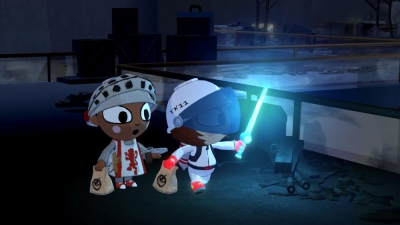
Ultimately, Costume Quest is a great game at any time of the year and I hope that the adventures I re-imagined in the Novel Gamer show are a fitting tribute, as well as an entertaining yarn. You can read the original story review and hear the podcast on GamePeople.

I had two major influences to which Costume Quest spoke. One was a lifetime love of the Peanuts strips writtem by Charles M. Schulz. I still find that Snoopy, Charlie Brown and the gang provide a wisdom and insight into the adult world which is remarkably accessible to young readers. Something about the humour and kinship in Costume Quest made me feel like I was in a Peanuts strip of my own.
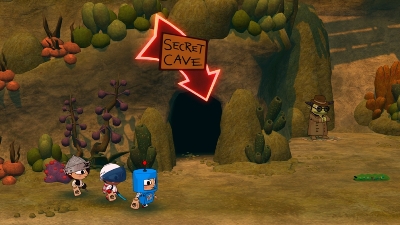
The other influence was Enid Blyton's much-loved stories and in particular The Secret Seven and the Famous Five. The idea of child heroes taking on forces which were far beyond them and having to operate within the confines of an adult-ruled world rang true with Costume Quest's adventures.
However, it was the culture shock element of Costume Quest which really informed the story. Hallowe'en is not as big a festival in the UK as in the United States, although it is certainly popular. The strange contrast of being a Brit and playing such a celebration of Hallowe'en made me think of the clash between Peanut's world and the Famous Five and so I decided to write a story about some very old-fashioned British children being brought face-to-face with their American counterparts.
Ultimately, Costume Quest is a great game at any time of the year and I hope that the adventures I re-imagined in the Novel Gamer show are a fitting tribute, as well as an entertaining yarn. You can read the original story review and hear the podcast on GamePeople.
Thursday, 27 October 2011
Novel Gamer commentary: A gap year with poor communication / Rupert's Safari
The Novel Gamer column often falls into one of two different camps. Sometimes the stories are parallels, hardly recognisable for the game that inspired them until the reviewing point I was trying to make is revealed. On the other hand it can be viewed as a kind of fan fiction. Writing an experience within the game world from the perspective of the player's character. This fan fiction approach was definitely the best way I found to explore my review of Monster Hunter Tri (Wii).
This usually happens with games that a: I find flawed and b: games that take themselves too seriously. A game that is very self-knowing and open to poking fun at itself is hard to parody and if I like a game then the desire to poke fun isn't there.
The story I wrote about Monster Hunter Tri reflected my disappointment with the game. With glorious landscapes, mythical creatures and adventure, it was meant to be the perfect getaway - like an exotic holiday. It made me think of the disappointment often experienced when holidays do not meet our requirements. With the no-frills mucking-in approach of the player, combined with the trendy tribal tattoos, for some reason I found myself thinking of a well-heeled Brit on a gap year, searching the world for the best experiences. This was also added to by the instinctive middle-class distaste I felt for the process of killing animals for sport. And so, Rupert was born.
My frustration with the game was largely due to the incredibly frustration Wii Speak peripheral: a factor that, to this day, still continues to put me off playing the game. In testing the multiplayer aspect of Monster Hunter, I enlisted the help of my excellent gaming buddy The_Killa_Bunny. I should point out that while the section with Zara is based on our experiences together, The_Killa_Bunny is not at all like Zara and is much nicer!
I think this one is a very entertaining story in its own right, while still being a fair critique of the game. Certainly I think anybody who plays Monster Hunter will be able to recognise much of what takes place. The original story and podcast can be found at http://www.gamepeople.co.uk/novel_wii_monsterhuntertri.htm.
This usually happens with games that a: I find flawed and b: games that take themselves too seriously. A game that is very self-knowing and open to poking fun at itself is hard to parody and if I like a game then the desire to poke fun isn't there.
The story I wrote about Monster Hunter Tri reflected my disappointment with the game. With glorious landscapes, mythical creatures and adventure, it was meant to be the perfect getaway - like an exotic holiday. It made me think of the disappointment often experienced when holidays do not meet our requirements. With the no-frills mucking-in approach of the player, combined with the trendy tribal tattoos, for some reason I found myself thinking of a well-heeled Brit on a gap year, searching the world for the best experiences. This was also added to by the instinctive middle-class distaste I felt for the process of killing animals for sport. And so, Rupert was born.
My frustration with the game was largely due to the incredibly frustration Wii Speak peripheral: a factor that, to this day, still continues to put me off playing the game. In testing the multiplayer aspect of Monster Hunter, I enlisted the help of my excellent gaming buddy The_Killa_Bunny. I should point out that while the section with Zara is based on our experiences together, The_Killa_Bunny is not at all like Zara and is much nicer!
I think this one is a very entertaining story in its own right, while still being a fair critique of the game. Certainly I think anybody who plays Monster Hunter will be able to recognise much of what takes place. The original story and podcast can be found at http://www.gamepeople.co.uk/novel_wii_monsterhuntertri.htm.
Wednesday, 19 October 2011
Novel Gamer commentary: Sex 'n' drugs 'n' Barrel-Rolls / Starfox Command Remembered
Starfox Command (DS) was where the Novel Gamer column began for me. I'd been talking with GamePeople about doing some writing for them. They review games from a number of perspective, including an "artistic" way which provides some great options for reflecting on a game.
With Starfox Comand, it wasn't so much the game itself I wanted to write about, but how I felt about it. It was a couple of years old by then, but the game was a classic - to me. I couldn't help but think that loads of people knew about the Starfox series but didn't appreciate how good Starfox Command actually was. So much so that I would actually say that it is the best Starfox game I have played.
I'm also really into music and it reminded me of the way a band with a long career often has albums from the distant past that have been overlooked in favour of glossy new compilations or an over-nostalgic reverence for the first release. It led me to thinking about telling Starfox Command's story as if Fox McCloud were an ageing rocker, being interviewed about past records in advance of a comeback tour.
The idea sat pretty well with me and I'm pleased to say that the opening episode of Novel Gamer almost perfectly crystallises everything I wanted to achieve with the show. The original story and podcast can be found at http://www.gamepeople.co.uk/novel_ds_starfoxcommand.htm
With Starfox Comand, it wasn't so much the game itself I wanted to write about, but how I felt about it. It was a couple of years old by then, but the game was a classic - to me. I couldn't help but think that loads of people knew about the Starfox series but didn't appreciate how good Starfox Command actually was. So much so that I would actually say that it is the best Starfox game I have played.
I'm also really into music and it reminded me of the way a band with a long career often has albums from the distant past that have been overlooked in favour of glossy new compilations or an over-nostalgic reverence for the first release. It led me to thinking about telling Starfox Command's story as if Fox McCloud were an ageing rocker, being interviewed about past records in advance of a comeback tour.
The idea sat pretty well with me and I'm pleased to say that the opening episode of Novel Gamer almost perfectly crystallises everything I wanted to achieve with the show. The original story and podcast can be found at http://www.gamepeople.co.uk/novel_ds_starfoxcommand.htm
Thursday, 13 October 2011
Novel Gamer Season 1 commentary
I write for GamePeople.co.uk under the name Novel Gamer. The basic concept was: rather than write standard critical reviews, I would try and express my thoughts about the experience of the game, or the reaction the game caused for me.
The name also refers to the way the reviews are presented as short stories. Taking the form of an allegory, Novel Gamer opens up a unique view into the world of a game. Sometimes seen as fan fiction, other times seen as an absurdist view of gaming and occasionally striking real entertainment gold. The first series of Novel Gamer ran for 20 episodes with podcast readings of the stories recorded by myself.
Over the next few weeks I'd like to look back at these stories and revisit why I wrote them the way I did. More soon.
The name also refers to the way the reviews are presented as short stories. Taking the form of an allegory, Novel Gamer opens up a unique view into the world of a game. Sometimes seen as fan fiction, other times seen as an absurdist view of gaming and occasionally striking real entertainment gold. The first series of Novel Gamer ran for 20 episodes with podcast readings of the stories recorded by myself.
Over the next few weeks I'd like to look back at these stories and revisit why I wrote them the way I did. More soon.
Tuesday, 22 March 2011
Novel Gamer Episode Eight - Pilotwings Resort, or "Learning to fly"
This is the eighth episode of the popular online alternative review column "Novel Gamer", part of Game People, which specialises in real world, alternative and artistic reviews. Don't forget that a podcast is also available from the source of this article, here.
This week, awoken by a mysterious message on his computer screen, an invitation leads Geo to a waterside warehouse where he must ask himself: does the Matrix have him? Or is the truth about the other side of the screen far more incredible?
This weeks' Novel Gamer review is based on reactions to a pre-release launch experience of PilotWings and is a preview, than a review based on a full assessment of the game.
This week, awoken by a mysterious message on his computer screen, an invitation leads Geo to a waterside warehouse where he must ask himself: does the Matrix have him? Or is the truth about the other side of the screen far more incredible?
This weeks' Novel Gamer review is based on reactions to a pre-release launch experience of PilotWings and is a preview, than a review based on a full assessment of the game.
...Wake up Geo
That was what the monitor screen said. It's appearance, unbidden, on my display had woken me from my light slumber as I lay on my couch with my DS on my chest. The battery had obviously died some time before. I was so tired when I had been playing I actually had no idea what I had been doing or what progress I may have lost.
At least I thought the text on the screen had appeared. I could picture it, but now the screen was blank. I half remembered that actually that was the beginning of a movie, so maybe it hadn't happened at all?
I stumbled into the kitchen, drew a glass of water, tipped some cereal into a bowl and sat down. The milk looked okay and I'd only bought it a couple of days before, but I still unscrewed the cap and gave the contents a sniff, automatically. Some habits you just get used to.
That day -- more than any other day -- I was strangely aware of my senses. The floor, between the kitchen table and the fridge had a slightly tacky patch. Not actually sticky, but maybe a place where a spill had once happened and been cleaned up, leaving only the faintest of adhesive traces. One end of the room seemed slightly darker, as though perhaps the bulb on that side of the fitting was on its way out. Condensation had formed on the tap spout where the cold water had escaped its confines for the alternative comforts of my glass.
There could be any number of reasons for my heightened feelings on that day. But, the reason I prefer to cling to is because that was the day I was about to have my eyes opened to a new world.
I've always been a gamer. From my earliest memories I recall slipping into an alternative world of adventure and intrigue on the other side of the screen. For me games have always enabled me to lose myself in an alternative reality. Much more than film with its fixed view on the action and its set narrative. The only other route I have ever found as effective for escaping from this world is books. It's not for everyone, but for the confident reader the barrier of the ink on the page melts away and the words and ideas are transported directly into the brain; to fire the imagination and to create a witness eye view on events that are unique to the reader.
The problem with games has been the thing it shares with film: the screen. In spite of its ability to display incredible vistas, gravity-defying moves, heart-breaking empathy and deep intrigue, it is the screen that reminds us we are trapped. Trapped in a world of mundanity, tethered to practicality and shackled to domestic limitation.
The screen gives us window into a world that is more alive and that accepts fewer excuses for what "cannot be done" within the bounds of physical reality.
That day was the day a man came who took the barrier away and enabled me to soar in the skies, as I used to in my childhood dreams.
If I could not be sure that I had seen the cryptic movie pastiche on my monitor I was in little doubt as to the reality of the card that had been pushed through my door.
It was clearly meant to serve as a business- or calling-card; however, it's dimensions were more reminiscent of a playing card. That certainly grabbed my attention. It featured a simple "?" mark.
I turned the card over, half anticipating something from the world of literary cliché: the ace of spades maybe, or the Tarot figure of Death grinning up at me. Instead, the reverse of the card featured a simple typed message: a local address and a time.
Looking at my watch I saw that I had just enough time to get ready and get to this meeting. There could be no question of my not following this invitation. Not only was the "?" mark on the card reminiscent of the prize boxes in Super Mario, but I couldn't help but think that if I had slept any longer I would not have been able to make this appointment; I thought back to those ghostly words on my screen.
I walked down to the docks. The address I had been given was for a waterfront warehouse, next to a small cafe. I decided I had no time for a tea break and headed inside. I was too excited about the wonder of this invitation to delay.
In the centre of the room stood a tall, imposing man in a long, black, leather coat. Beside him on a table was what appeared to be a Nintendo DS.
"Welcome, Geo" the man intoned. "I am glad to meet you. I believe that you are a man with a problem. A problem I hope to solve."
I nodded my head, "you're talking about the games."
"I'm talking about the reality you create for yourself, Geo. You who have always loved the excitement of exploring other worlds and doing things that no person could hope to experience in reality but who always feels like you are kept on the outside. Are you ready to go deeper into the game?"
I frowned, trying to understand. "You're talking about increased immersion?"
He replied, quickly, "I'm talking about reality, Geo. What is real? If real is what you can feel, smell, taste and see, then 'real' is simply electrical signals interpreted by your brain. If you can convince your brain that an image you are seeing is in three dimensions -- 'appears' solid -- then who is to say it is not real?"
He held up his hand dramatically and I could see that he was holding a pair of old-style 3D glasses, with coloured lenses. "You have a choice," he announced, "look through the blue lens and you will see the world as it has always been, flat and dull ... ummm..." he faltered, "and looking a bit blue..."
I raised my eyes to the ceiling. The dramatic mood had been broken.
He continued unabated, "look through the red lens and you'll see, well, exactly the same thing." I think he sensed he was losing me, as he went on, hurriedly, "but if you look through both -- here's the thing -- it also changes nothing! What I am about to show you doesn't require glasses." He threw them over his shoulder and they landed in a puddle of water leaked from somewhere high in the ceiling.
He opened up the machine on the table. "This," he declared, "is the Nintendo 3DS and it will show you a world of which you have only dreamed." He stuck out a hand towards me, palm up, "the card, please."
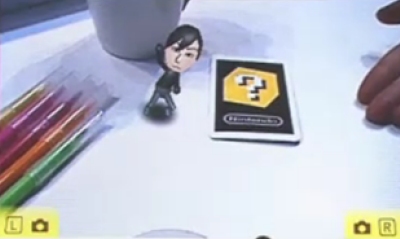
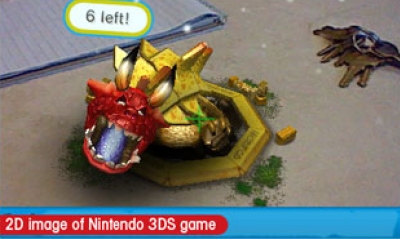
I reached into my pocket and recovered the calling-card that had been pushed through my door. As I placed the card down on the table, "?" mark facing up, he handed me the 3DS and I focused on the image of the card on the screen. It wasn't like looking through a camera lens. It was like seeing the table in front of me with fresh eyes. A 3D viewport onto the world as it is. Then the 3DS showed me the world as it could be: the card unfurled, revealing a deep recess in the table. A dragon head on a long neck extended out and toward me.
I was reeling, "but this is incredible!" I called out.
"Patience, Geo," he said, raising a hand "I agree this is impressive, but the dragon is only to demonstrate that the world is not necessarily as you see it. Let me show you what you are really here to see; what you really came to do..."
*****
I felt myself soaring high above the ground, floating over the sea and onward, ever toward my target. The clouds parted and I saw the world laid out before me. It was like the world, only at the same time not like it. It wasn't drab, grey and mundane -- this was a world inhabited by living colour as though the sea was trying to be as blue as it could be and the grass exerting itself to be the greenest grass the world had ever seen.
The world was so ... if I had to settle for a word, I'd have to go with 'real'. Not the kind of real I expected. It was not our world reproduced on the screen. If anything it was the reverse. It was as though the world of the games had been made solid and brought into our reality. Before, these places had always seemed like colourful sketches in some framed picture I could never enter. Now they lived and breathed in three dimensions and it was like seeing a cartoon hero come to life.
The flying itself was breathtaking. The ease with which I could soar through floating rings seemed to come naturally to my fingers and I glided over the beautiful island paradise and landed the aircraft gently on the waves exactly as I had been taught.
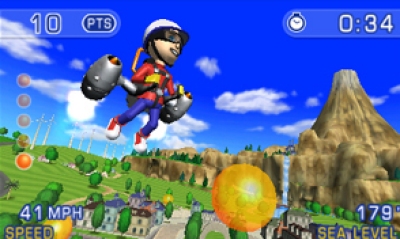
The dream changed and I found myself hanging in the sky, held aloft by a jetpack. It was a fun variation on the controls required by the plane and I propelled myself forward, through balloons onward towards the goal.
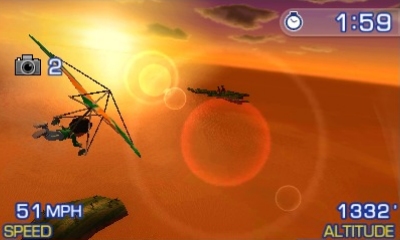
The dream changed once more -- now I was whooshing over the mountaintop, suspended from a hang-glider. The world was so deep and so intense and I wanted to explore every part of it, but I felt myself being pulled away.
I blinked and found myself back in the room with the stranger.
"How was it?" he asked me.
"I feel," I struggled to find the words, "I feel like I've held a world in my hands, a world that I can enter whenever I choose and fly over, under, through and across. I want to explore every inch of that world from my vantage point in the sky. It felt real. It was almost too deep. Sometimes I felt like the gulf of depth was too massive and I wanted it to feel a bit flatter... incredible."
I rubbed at my eyelids, "why do my eyes hurt?"
The figure looked at me poignantly, "because you've never used them before."
I made to pick up the Nintendo 3DS again. I desperately wanted to fly some more.
He stopped me. "That is all you can see for now. It is time for you to return home."
I was incredulous, "but I've just seen the most incredible things! I've seen the world of games as it could be and I'm not sure if I can return to the other side of the screen! I want to spend more time here and see more and fly more..."
He nodded, kindly, "the world you seek is coming soon, Geo. It is only a few short weeks away and you will be able to return to the real side of the screen again. For now, you must spread the word that others may be enlightened."
*****
My alarm clock beeped loudly and I awoke. I could hear the rain lashing against the glass.
I rubbed the sleep from my eyes and, in doing so, I remembered the adventure with the Nintendo 3DS. I remembered getting my pilot wings and soaring high above the ground.
I looked out of the window and could see blue sky breaking between the grey clouds. I had had the most incredible adventure, journeyed to a colourful world and flown... and then had it taken away before I was ready; before I had had a chance to see it all.
The memory felt like the aftertaste of a sweet dessert in my mouth. In my heart I knew I was desperate to fly again. It had all felt so real to me.
It couldn't have been a dream, could it?
Thursday, 17 March 2011
Novel Gamer Episode Seven - Starship Patrol, or "Commander on Trial"
This is the seventh episode of the popular online alternative review column "Novel Gamer", part of Game People, which specialises in real world, alternative and artistic reviews. Don't forget that a podcast is also available from the source of this article, here.
This week, a space fleet commander - on trial for competency - must justify his actions and approach to a controversial fleet battle, amid tales of weapons shortages and very basic video displays.
This week, a space fleet commander - on trial for competency - must justify his actions and approach to a controversial fleet battle, amid tales of weapons shortages and very basic video displays.
Across the stars, nestled between floating chunks of space rock and debris, the Space Station Zenobia drifted along in its quiet orbit between the planetary mass hundreds of miles below and the nearby moon.
Commander Jayston stood up from his seat in the congregational chamber and placed his hands on the wooden bar of the dock. He faced the panel of senior officers before him and awaited their instruction.
Admiral Langford eyed him impatiently, as if unaware that the assembled court was waiting upon his word to commence. His head was slightly bowed and he frowned as he stared at Jayston through thick white eyebrows. He opened wide a thin pair of cracked, wrinkled lips to reveal a small row of yellowed, gravestone teeth and barked commands.
"Well, man? The oath! Get on with it."
Commander Jayston raised his hand in the air. "I swear that my testimony shall be the truth, the whole truth and nothing but the truth."
The Admiral clicked his tongue in acknowledgement and straightened up, eyeing the assembled crowd. "In that case," he declaimed, "I declare this initial meeting of the military competency hearing panel open."
He locked eyes with Commander Jayston once more, "you understand that the purpose of this hearing is to hear a full account of your version of the events that took place on the outer rim during your campaign?"
Jayston replied, "yes, sir."
The old man continued, almost without waiting for the response "and you understand that this hearing is not questioning the outcome of that campaign - generally considered to be quite satisfactory - but rather to establish the efficacy of your conduct and approach in its execution? There are a number of areas in which your performance has been called into question, on the basis of the official logs, recordings and witness testimony."
"Yes, sir."
Another officer to the Admiral's right, whose name plaque declared him to be Admiral Bryant, spoke up. "Perhaps, Commander, you could begin by telling us how the conflict started?"
"We set out to perform a routine survey of an alien system, but were set upon at every turn. Nevertheless our orders were to proceed with the mission." Jayston replied.
Admiral Langford curled his lip. "I see," he growled, menacingly, "and that brings us to the first of your engagements with the enemy. Can you explain to us, Commander, exactly why you went into your first battle with the enemy entirely un-armed?"
"Well, sir," Jayston stammered, "The ships had been built with a number of standard mounting-ports to which weaponry could be assembled at short notice -- however due to the available resources we did not have any standing defences."
The panel murmured and shared glances between themselves. "So what did you do when the first enemy craft began attacking?"
"We generally have enough resource budget for two slow-repeating lasers or one missile silo depending on circumstance. Owing to our tactical systems we were able to predict the flight path of each enemy wave. We placed the weapons such as we had in what I felt to be the optimum position to handle each encounter. As the enemy fell, we recovered what resources we could from these craft and converted them into additional weapons as the exchange continued."
"And this is standard practice, is it?" Admiral Langford enquired.
Commander Jayston nodded, curtly, "in these kinds of engagements, I believe it to be a common type of defensive strategy."
"So," Admiral Langford cut in, "you faced the enemy with your fleet, based upon a hand-to-mouth strategy whereby the resources generated by one defeated wave would feed into your defences for further attacks?"
The defendant nodded once more, trying to anticipate the Admiral's next barbed comment as accurately as his ship was able to determine an enemy's flight path.
The Admiral leant back languorously in his chair and cast a hand theatrically around the assembled room. "Am I the only person present who feels it would be a more appropriate strategy to meet the enemy with a properly prepared and equipped defence grid? Rather than deploying weapons one at a time to meet specific engagements?" His voice rose dramatically in line with the hyperbole.
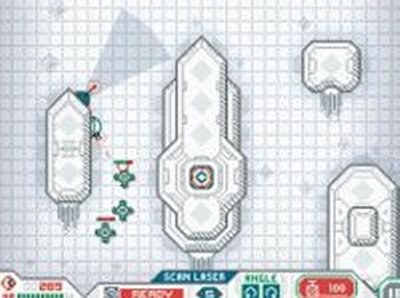
"But, Admiral," Commander Jayston protested, "we really only had enough budget to deploy two weapons!..."Exhibit A: The tactical display of the battle
There was a general murmuring in the court which had to be quietened by the officer on the other end of the panel, another Admiral by the name of Bellingham.
Admiral Langford himself leaned toward Jayston and smiled sweetly. It reminded Jayston of the way a crocodile looks as it glides effortlessly through the water. He gulped, involuntarily.
"That budgetary issue being the case, Commander," the Admiral said, at last, breaking the tension, "with what defences did you begin the second engagement?"
Jayston chewed on his lip, "ummm, none, sir."
Langford put on a faux expression of confusion, "but by the end of the first battle you must have amassed quite a sizeable arsenal?" Why was this not re-deployed when the enemy attacked a second time?"
Silence fell heavily upon the room, awaiting Jayston's answer. He finally said, simply, "I don't know, sir."
The Admiral pursued him, "I cannot think of a good reason why the resources available to your fleet should not be made available in subsequent battles. Can you?"
Commander Jayston simply shook his head.
The three admirals behind the long counter exchanged glances with one another and then bowed their heads to make notes, almost in unison.
Admiral Bellingham spoke next, "Commander, perhaps we could move on to the issue of your performance in the individual skirmishes. This appears to be a very mixed area. In some battles you display an exemplary performance -- occasionally leaving the enemy without a single remaining unit -- while in other battles you barely escape with your fleet intact. Do you have an explanation for this fluctuation in your abilities?"
"Yes, sir, I do," Commander Jayston replied hopefully, "I believe that the primary responsibility for our variable success with the enemy must lie solely at the feet of our Research and Development department."
This prompted an explosion of coughing and outraged bluster from Admiral Langford. "What?" he demanded, "you blame the weapons development team for this? Explain yourself!"
"Certainly, sir," Jayston replied, "throughout the campaign, R&D occasionally provided new weapons based on their work and the alien encounters. However, the enemy demonstrated time and time again that they were capable of deploying cloaked ships which were impervious to all but a minority of our weapons. In spite of the effectiveness of these enemy units and the problems which they caused us in our defence, R&D failed to provide any weaponry which was effective against these craft. In desperation I had to form my own approach -- while the mine layers are generally ineffective they do cause the enemy ships to de-cloak at which point better weapons could be brought to bear. However the effectiveness of mines is unpredictable and results are largely random. Sir."
Admiral Langford had an expression on his face which looked as though he were trying to remove stuck gum from the roof of his mouth. "I see," he eventually replied.
Bellingham chipped in, "but it's not all down to the weapons, is it? Some of the targeting is off! Why we have pictures here which show your most effective weapons firing upon lone, weak targets while elsewhere three heavily armed fighters attack your ship!"
Commander Jayston retorted, quickly, "I have very little control over the targeting, sir. All I can specify is an area in which the guns will fire. They choose their own targets -- very poorly if I may say so, sir."
"And to what," Langford said, slowly, "do you attribute this failure?"
Jayston thought for a moment, carefully -- he didn't want to dig himself further into a hole but he didn't feel he could go any longer without raising this particular issue. "I think the fault is the graphics display, sir."
The admirals raised a line of eyebrows, almost as if choreographed.
"The tactical display looks like.. like.." he struggled for the right words, "well sir it looks like it's been hand drawn on lined paper! It's hardly representative of a real battle, is it? Umm, Sir."
Admiral Bryant asked him, "what would you prefer?"
The young Commander was a little taken aback by this question, "well Sir... I ... ummm... think it would be more effective, given the setting, to be presented with a realistic camera display of the ships involved in battle."
Langford picked up his colleagues line of questioning. "Commander, what colour is space?"
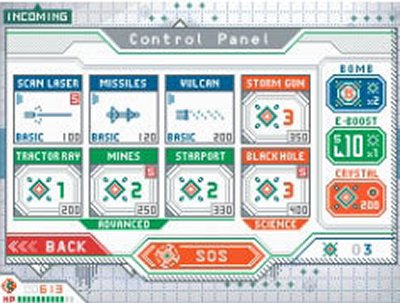
"Black, sir."Exhibit B: Weapons often available by the end stages of a battle
"And are most of the enemy ships a brilliant white, or a different colour?"
"Umm mostly darker colours than white, sir."
"And the projectiles and resources involved -- are they dark or light colours, in reality?"
Jayston's heart felt like it was plummeting through depths to rest at the bottom of a deep lake. "They are dark colours, sir."
Admiral Bellingham said, "whereas the graphical display for your fleet's command console displays the enemy on white screens with clear black outlines and makes all resources and projectiles very clear."
The Commander chose to not respond to this statement.
"Do you still feel that the display style is at fault, Commander?" Langford asked him, bluntly.
"No sir." Jayston replied. What else could he say? He watched dust particles dance in the rays of light coming through the viewports behind the panel. Was this to be the end of his career?
The three admirals adjourned to a private room to discuss the facts. It seemed to Jayston as though there was no hope.
The waiting seemed eternal, although in actuality less than five minutes had passed. The ante-room door opened and the three stooped, elderly soldiers filed back into the room.
Admiral Langford looked intently into Jayston eyes. "Having looked at the records of your performance and the overall outcome of the campaign -- as well as other mitigating factors -- we find no grounds on which to bring charges of misconduct or competency. You are free to leave."
Jayston was stunned; but at the same time he was suddenly curious. "If I may ask, sir... what other mitigating factors?"
The panel simply stared at him and offered no response.
Moments earlier, the panel of three judges had congregated in the ante-room behind the congregational chamber. They exchanged glances.
"Well," Bryant was the first to speak, "what do you think of it all?"
Langford growled, "I don't like him. Starting a battle with no defences, refusing to redeploy weapons once they are positioned...."
Bryant cut in, "his records indicate that he found the budgetary cost of removing a weapon once it was installed was prohibitive to making any changes. His complaint about this is noted in his report."
There was a moment where nobody spoke -- just thought about how to pass judgement on this episode.
Admiral Bellingham cleared his throat, softly and with a conspiratorial tone, suggested "we could of course look at this from a sideways perspective. Due to the way in which Jayston's fleet is housed he can be called upon at a moment's notice -- rather than some other war games which require us to find the appropriate records and install them. Also, this whole incident hasn't cost very much."
"Cost?" Langford demanded, "what do you mean?"
"Well," Bellingham continued, "according to our records this whole affair has only cost our department 500 DS Points."
Langford and Bryant looked at each other and raised an eyebrow. "We should probably overlook a few indiscretions, then?" Bryant offered.
Admiral Langford nodded gravely, "I think," he announced with an air of pontification, "that that is exactly what we should do."
Friday, 4 March 2011
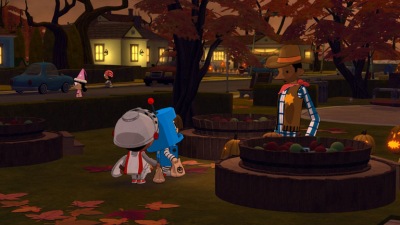
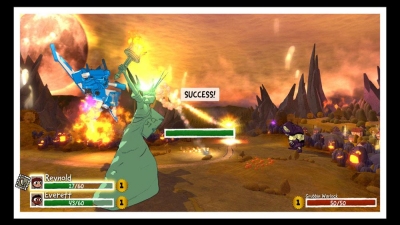
Novel Gamer Episode Four - Costume Quest, or "The not-so-famous four do hallowe'en"
This is the fourth episode of the popular online alternative review column "Novel Gamer", part of Game People, which specialises in real world, alternative and artistic reviews. Don't forget that a podcast is also available from the source of this article, here.
This week, The Not-so-famous Four do Hallowe'en: The protagonists of Costume Quest are visited by their old-school British cousins and have a thoroughly chipper time!
This week, The Not-so-famous Four do Hallowe'en: The protagonists of Costume Quest are visited by their old-school British cousins and have a thoroughly chipper time!
It was the first time the Parker children had visited the United States of America. It had also been many years since James and Alice had seen their cousins. What with the excitement of travelling, unsupervised, across the Atlantic on an aeroplane -- although James had suspected the air stewardess had been tipped to keep an eye on them both, much to his chagrin -- Alice was quite beside herself!
"Oh James, isn't it simply too wonderful?" Alice bounced on the back seat of the car, sent to pick them up by their American uncle Victor.
"I say, Alice, do calm down," James told his younger sister. When the two of them were out together James always put on an air of superiority and sophistication, as if he were automatically in charge when Mother and Father were not around. Alice found it most irritating. James paid her be-freckled frown no heed, "we're being seen in this fine country for the first time and I shan't have you making us both appear to be a pair of country bumpkins."
Alice stuck her tongue out at him; an action which she knew would put his back up. She crossed her arms and pouted. She did hope her brother was not going to be a pompous Billy for the whole fortnight!
It was noticeably much warmer here than at home, Alice thought. James squirmed uncomfortably in his seat. He was wearing the sweater which Mother had knitted for his last birthday and it was clearly making him too hot yet he refused to acknowledge this and take it off.
They arrived at their cousins' home quite quickly and were greeted by a pair of unfamiliar faces running down the path in front of the house.
"Gosh, is that them?" James exclaimed despite himself.
"Of course it is, silly," Alice nudged him in the ribs, "it has been many years since we saw them. I dare say we must appear very different to them as well!"
The two cousins stood on the pavement and stared at them; One of them appeared a scrawny but agile looking young man with a mop of brown hair and the other a girl with a short crop of black hair. The boy was called Reynold and the girl Wren. It was apparent to any observant passer-by that they were twins.
Alice simply stared at the girl with her mouth open. The girl's hair was cut quite short at the sides and back and she was wearing jean trousers and a T-Shirt. She couldn't help herself but was terribly aware that she was making ‘O' faces like a goldfish.
Wren came over to her. "Gaht a problem?" she said to Alice, the drawl of her accent totally unfamiliar to the newcomers.
Alice composed herself and looked down at her own attire. "It's just," she began, nervously running her hands down her own green gingham dress, "don't they have pretty girls' dresses here in America?"
"Ha!" the other cousin laughed, giving his sister a firm slap on the shoulder, "it'll be a cold day in hell before this one pretties herself up. I reckon she's more of a guy than I am!"
The girl gave him a reciprocal punch in the gut. Alice looked genuinely horrified.
"Whatever!" the girl said, "I ain't got a problem with dresses. They're just no good for runnin' and fightin'!" She gave Alice a huge grin, once more exposing her missing tooth.
"James Parker at your service," James stepped forward and offered Reynold his hand in a formal handshake.
"Mighty fine to meet you, cuz," Reynold clapped his hand fast and shook it vigorously. "You've picked a great time to come and visit. Y'all can help us make costumes!"
"Costumes!" Alice clapped her hands, delightedly. "Oh I say, whatever for?"
Wren beamed broadly again and whistled through her gappy grin, "you got here jurst in time for Hallowe'en -- we's going Trick or Treatin'!"
James wasn't sure he understood the fascination with All Hallow's Eve, but Reynold and Wren seemed to be excited enough for the four of them. Alice got stuck into her dressmaking of course. It occurred to James that as Alice sat under the tall lamp, with a lap full of material and sewing needles held between her teeth, she was the very image of their Mother.
The costumes were assembled as follows. Reynold had insisted on a Robot theme as he was fascinated with the subject. He had fashioned an outfit from two cardboard boxes with a visor cut from the helmet and a pair of wings drawn on the back. Wren wanted to wear something dashing and heroic, so with a little help from James had creating a medieval knight's costume, complete with a shield and sword made from aluminium foil and wrapped around cardboard. Alice wanted something elegant, so Wren's mother had found her a length of green fabric which she had swirled about her person in the manner of the Statue of Liberty. James had found an old dress cape and attired himself as a vampire.
"That's creepy," Alice told him, "I don't know why you want to wear something so horrid!"
James protested, "I thought this was meant to be a scary holiday. I'm just getting into the spirit of things!"
Reynold came over. "Ahh we'll show you the real meaning of Hallowe'en," he said and handed them each a small bag.
"What's this for?" Alice quizzed him.
"That's for the Trick or Treating, silly," James told her in his authoritative voice. "We're going to knock on the doors of local houses and ask them for sweets."
Alice huffed at her brother. He always had to be a know-it-all!
"He's right," Wren spoke up, "by the end of the night we should have bags full of candy!"
They headed out into the night air and were waved on their way by Reynold and Wren's mother and father.
Alice was astonished. "Really? We're allowed to stay out all evening unsupervised?"
They had not been out for long before they noticed that something was not quite right. There was a suspicious looking gentleman skulking near the gates to a nearby cemetery. James thought he might be a foreigner. He was dressed in sackcloth and his skin was a dark green. He looked quite monstrous and his costume was far too realistic for Alice's liking.
Suddenly, he rushed forward to attack them and as he came into the light they could all see that he was an actual goblin!
Alice's instinct was to drop her bag and run. The others, however, reacted very differently. Wren and Reynold seemed braced for a fight. Before they could react, another goblin from out of sight had grabbed James and had run off with him!
That was when the queerest thing occurred. It seemed to Alice that they all grew tremendously in stature; it was as if she was the Alice in the Wonderland and had eaten the mushroom. As they grew their costumes seemed to shift and change. Also, where one goblin had stood for some reason there now were three!
With a clank of metal and pistons, Reynold now stood a hundred feet high; his limbs were polished steel and his eye a vicious camera. He leapt high into the air and pointed his arm at the attackers. His fist came loose and launched at the first goblin like a rocket.
Alice turned to comment to Wren and instead came face to face with an armour-clad knight. Where there had been aluminium, now there was steel. A gruesome helmet covered Wren's features. She leapt forward and smote the second goblin with her large sword.
One of the goblins made a move toward Alice. She was most perplexed at being this tall and really didn't know how to fight. With a gasp, Alice realised the toy torch that was part of her costume now bore a genuine flame. She waved it at the goblin to ward it off and was most surprised when a flame, like the breath of a dragon, leapt from her torch and burned the goblin.
Reynold drew himself out and puffed up his chest. Miniature red tips appeared in his armoured metal chest and shot forth: a wave of rockets weaved and arced toward the assembled goblins. There was a flash of fire and a shower of tiny wrapped sweets and the goblins were no more. As ash fell and the debris settled the children felt that they were returning to their normal size and attire.
Alice wasn't sure what to say, but settled on a heartfelt "gosh!"
It was the most wonderful adventure, Alice would recall later.
They had set off to rescue James, of course. There could be no other course of action what with him being kidnapped by suspicious individuals.
With some guilt, Alice had to acknowledge that they hadn't exactly taken the quickest path to rescuing her brother. The thing was that there were simply so many exciting things to do around Hallowe'en. They found themselves involved in a game of hide and seek with six other children; there was bobbing for apples (Alice did very well at this game on account of the village fete some weeks before when Alice had gotten plenty of practice) and lots of picture cards to find and even trade with other people.
Eventually they had gone after James and found him being held in what Reynold and Wren called a "Mall". There were lots of things to do here, too, but Alice couldn't help but feel that all of the games were quite similar. They played another game of hide-and-seek, did more apple bobbing and traded some cards.
The trail led them from the mall to a carnival outside town. It was very pretty and nice to have some different scenery but Alice was beginning to grow weary. There was another game of hide-and-seek! And another round of apple bobbing! It seemed that no matter where they went they were being forced to play the same games over and over.
Alice did find that she was enjoying herself greatly, however, in spite of the repetition. "Perhaps people over here don't mind doing the same things again and again," she mused to herself.
One of the things that had kept their adventure lively was that as they travelled around they were given designs for new costumes. They also had a bit of a treasure hunt to find the items to make these new costumes. They looked the part now! Alice was very pleased to have a pretty horse outfit which could shoot rainbows from its mouth. Wren had fashioned herself a jack-o-lantern outfit which blazed with fire whenever they had to fight more goblins. Reynold was dressed with little cat ears that made him look most amusing and adorable -- however when they fought he became a giant black panther that tore into their enemies.
It was, Alice thought, all totally spiffing!
They'd had to get James back, of course. It would have been totally unthinkable to have returned home without him. "What would Mother and Father have thought?" Alice mused to herself as she, James, Reynold and Wren sat on the pavement thoughtfully chewing on the night's takings.
James was, of course, acting very stoic and pretending he was in charge of the whole affair.
"I shouldn't have been in any trouble," he told them all, "I should have escaped before long. You chaps just saved me the trouble by arriving sooner."
"Sure," both Wren and Reynold said at the same time, and then looked at each other, surprised.
Alice began to laugh at this. James joined in too with big hearty belly laughs. Wren and Reynold looked nonplussed for a moment and then a smile cracked across their faces and they laughed with them.
They were all still chuckling as their adventure ended and they found themselves once again at home.
Friday, 24 December 2010
Why I won't be playing Nintendo's latest diving-inspired game
I love the Endless Ocean games.
I'm a diver myself; although the Endless Ocean series cannot replicate the charm and thrill of real diving it does have the same relaxing feel of floating through a hidden world simply for the pleasure of taking a look at what there is to see and exploring secret places.
It's not without it's inaccuracies in terms of the game's approach to the technique of diving; however, with Endless Ocean there appears to be an awareness of some of the detail of the sport: air is consumed more at greater depth, air is also consumed under stressful circumstances and specialised breathing equipment is required for deep dives.
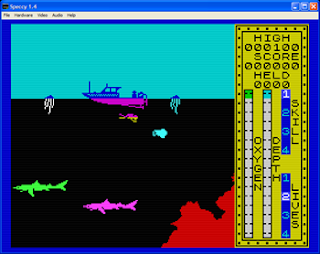
Nintendo have recently released demos for some of their WiiWare releases. I thought I'd take a look at Dive: The Medes Island Secret. It has a similar visual fidelity to Endless Ocean but utilises a fixed side-scrolling camera and is akin to the retro Sinclair Spectrum game, Scuba Dive (pictured).
The game takes as its premise the search for lost gold in a Mediterranean stretch of coast. However this game almost immediately horrified me in its portrayal of the sport and the underwater environment.
You enter the sea armed with a spear gun. Fish or plants that block your path are to be shot; especially fish which "attack" in the game, depicted in the demo as Lionfish - a fish which in nature present little or no aggressive behaviour towards humans. Most injuries are as a result of divers carelessly swimming into their venomous spines.
It's bad enough that careless fishing, reckless or thoughtless divers and large shipping damage the marine life in our seas. To depict a game in which the fish can be targeted and shot with a spear is incomprehensible to me and certainly should not be present in a game based upon the sport of Scuba Diving.
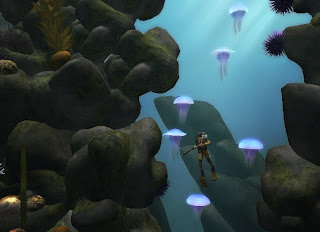
In Endless Ocean, the fish are there to be studied and observed. True, in Endless Ocean 2, the player is provided with a "gun" of sorts which is used to pacify aggressive predators and heal sick fish, but this device is a suitable science-fiction idea it provides little to suggest the fish are to be harmed. In Dive, however, the fish cannot be interacted with at any level beyond shooting - in spite of the in-game shops assertion that the spear is a "tranquiliser" this is clearly a post-production addition as the in-game animation shows fish which have been shot turning upside down and floating to the surface. It is clearly a weapon designed to kill.
The ignorance of the sport does not end there. I was briefly impressed that the game depicted Oxygen Toxicity damaging the player's health when attempted to swim below a 60m depth. However, when I looked in the in-game shop for items the game depicts a "special wetsuit" which must be used for deep dives.
Research is important in any game which depicts real life sports, people or events. Dive: The Medes Island Secret displays a complete ignorance of the sport and a lack of sensitivity to the issues we have created for the marine environment.
I would heartily recommend both Endless Ocean titles for anyone looking for a reasonable replication of the sport of Scuba Diving.
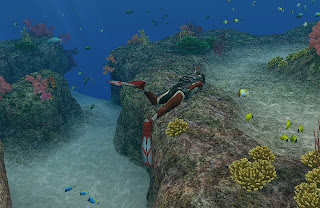
I'm a diver myself; although the Endless Ocean series cannot replicate the charm and thrill of real diving it does have the same relaxing feel of floating through a hidden world simply for the pleasure of taking a look at what there is to see and exploring secret places.
It's not without it's inaccuracies in terms of the game's approach to the technique of diving; however, with Endless Ocean there appears to be an awareness of some of the detail of the sport: air is consumed more at greater depth, air is also consumed under stressful circumstances and specialised breathing equipment is required for deep dives.
Nintendo have recently released demos for some of their WiiWare releases. I thought I'd take a look at Dive: The Medes Island Secret. It has a similar visual fidelity to Endless Ocean but utilises a fixed side-scrolling camera and is akin to the retro Sinclair Spectrum game, Scuba Dive (pictured).


The game takes as its premise the search for lost gold in a Mediterranean stretch of coast. However this game almost immediately horrified me in its portrayal of the sport and the underwater environment.
You enter the sea armed with a spear gun. Fish or plants that block your path are to be shot; especially fish which "attack" in the game, depicted in the demo as Lionfish - a fish which in nature present little or no aggressive behaviour towards humans. Most injuries are as a result of divers carelessly swimming into their venomous spines.
It's bad enough that careless fishing, reckless or thoughtless divers and large shipping damage the marine life in our seas. To depict a game in which the fish can be targeted and shot with a spear is incomprehensible to me and certainly should not be present in a game based upon the sport of Scuba Diving.

In Endless Ocean, the fish are there to be studied and observed. True, in Endless Ocean 2, the player is provided with a "gun" of sorts which is used to pacify aggressive predators and heal sick fish, but this device is a suitable science-fiction idea it provides little to suggest the fish are to be harmed. In Dive, however, the fish cannot be interacted with at any level beyond shooting - in spite of the in-game shops assertion that the spear is a "tranquiliser" this is clearly a post-production addition as the in-game animation shows fish which have been shot turning upside down and floating to the surface. It is clearly a weapon designed to kill.
The ignorance of the sport does not end there. I was briefly impressed that the game depicted Oxygen Toxicity damaging the player's health when attempted to swim below a 60m depth. However, when I looked in the in-game shop for items the game depicts a "special wetsuit" which must be used for deep dives.
Research is important in any game which depicts real life sports, people or events. Dive: The Medes Island Secret displays a complete ignorance of the sport and a lack of sensitivity to the issues we have created for the marine environment.
I would heartily recommend both Endless Ocean titles for anyone looking for a reasonable replication of the sport of Scuba Diving.

Thursday, 2 December 2010
Friday, 29 October 2010
GameCity5 - Day Three - Old games and new faces
This morning's Guardian breakfast posed some interesting food for thought: what are the games that marked the most significant milestones in gaming history. Clearly a contentious topic and I won't go in to the list here; I think that most people, when faced with the list, would come up with alternative games that they feel are more significant for different reasons.
It rings true though, that there are certain games which simply change something in your mind about how games work or the potential for games to work. In part of today I saw a group of graduates discussion their first commercial venture, QUBE. As the game is a first-person-puzzler (for want of a better term) it draws comparison to Portal, although there appears to be no desire to add plot or implied narrative to the puzzles.
These two things coming together reminded me what is so startling about Portal. In terms of gameplay it is an extremely clever way to frame a puzzle game. What is more remarkable is the way in which a rich narrative is told without any secondary characters (apart from the voice), cutscenes or story events. As a distinction from, say, Myst - which is an adventure game with puzzles inserted - Portal is a puzzle game with a rich, hidden narrative. It's like being presented with a wordsearch in which the shape of the lines form words across consecutive pages to read "HELP ME IAM HELD PRIS ONER".
All of which mental wanderings bring me to the second of Jonathan Blow's presentations which I attended about his new game The Witness. Loved by many for creative the 2D time-shifting platform-puzzler Braid, many were, perhaps, surprised to find that his new project is set in a 3D environment with first-person controls. Chris Hecker (Spy Party) was in the position, as friend of Jonathan, to ask the inevitable cheeky question: "So what do you say to the young developers we are always telling to avoid 3D and make 2D games?"
It rings true though, that there are certain games which simply change something in your mind about how games work or the potential for games to work. In part of today I saw a group of graduates discussion their first commercial venture, QUBE. As the game is a first-person-puzzler (for want of a better term) it draws comparison to Portal, although there appears to be no desire to add plot or implied narrative to the puzzles.
These two things coming together reminded me what is so startling about Portal. In terms of gameplay it is an extremely clever way to frame a puzzle game. What is more remarkable is the way in which a rich narrative is told without any secondary characters (apart from the voice), cutscenes or story events. As a distinction from, say, Myst - which is an adventure game with puzzles inserted - Portal is a puzzle game with a rich, hidden narrative. It's like being presented with a wordsearch in which the shape of the lines form words across consecutive pages to read "HELP ME IAM HELD PRIS ONER".
All of which mental wanderings bring me to the second of Jonathan Blow's presentations which I attended about his new game The Witness. Loved by many for creative the 2D time-shifting platform-puzzler Braid, many were, perhaps, surprised to find that his new project is set in a 3D environment with first-person controls. Chris Hecker (Spy Party) was in the position, as friend of Jonathan, to ask the inevitable cheeky question: "So what do you say to the young developers we are always telling to avoid 3D and make 2D games?"

Jonathan laughs, caught out. "We always say," he tells the audience, "the worst mistake is to make a 2D indie game ... make a decent amount of money to fund future development and then try something ambitious and obscure in 3D that no-one wants to play and lose all your money ... I'd never recommend to anyone to do what I'm doing."
But the reason for this departure is a deep love of adventure games, or a least a deep love of what adventure games should be. Speaking on the death of adventure games, Jonathan says "other games evolved to be more playable - adventure games never figured out how to do that." Frustrated by a genre which mostly revolved around hoarding inventory items, randomly combining objects and failing to interact with scenery, Jonathan has set out to make a true adventure game which combines the joy of exploration with environment based puzzles which play by a fair set of rules.
He demonstrates a good set of the opening of the game and it is clear that the player is taught how to understand the puzzles in the game a little at a time, without any text displays or audio prompts. Simple line puzzles build into basic mazes and then evolve into complex mazes with pathing rules. Basic levers are identified early as well as active and inactive switches and through an elegant opening puzzles players are taught how power lines from nearby puzzle stations to environmental objects allow passage.
The game itself was subjective to a blind playtest at Pax, without the gamers being told it was by the Braid creator. "I don't really like feedback," he causes the audience to laugh, "[the pax playtest] was more of a reality check."
There is an obvious disconnect between the puzzles and the setting. Jonathan insists that this is in keeping with the fiction of the story as well as providing a fair interface for players. "In a game like Myst each machine is disguised to go with the scenery so the player spends ages just trying to figure out how the buttons move or if its a screen or whatever."
But the reason for this departure is a deep love of adventure games, or a least a deep love of what adventure games should be. Speaking on the death of adventure games, Jonathan says "other games evolved to be more playable - adventure games never figured out how to do that." Frustrated by a genre which mostly revolved around hoarding inventory items, randomly combining objects and failing to interact with scenery, Jonathan has set out to make a true adventure game which combines the joy of exploration with environment based puzzles which play by a fair set of rules.
He demonstrates a good set of the opening of the game and it is clear that the player is taught how to understand the puzzles in the game a little at a time, without any text displays or audio prompts. Simple line puzzles build into basic mazes and then evolve into complex mazes with pathing rules. Basic levers are identified early as well as active and inactive switches and through an elegant opening puzzles players are taught how power lines from nearby puzzle stations to environmental objects allow passage.
The game itself was subjective to a blind playtest at Pax, without the gamers being told it was by the Braid creator. "I don't really like feedback," he causes the audience to laugh, "[the pax playtest] was more of a reality check."
There is an obvious disconnect between the puzzles and the setting. Jonathan insists that this is in keeping with the fiction of the story as well as providing a fair interface for players. "In a game like Myst each machine is disguised to go with the scenery so the player spends ages just trying to figure out how the buttons move or if its a screen or whatever."

Following this I had the honour of being invited to a presentation by some students and ex-students from Newport Uni's games design course. Having now witnessed Jonathan Blow describe twice the process of educating a player about the rules of a game it's encouraging to see that these less-experienced graduates have taken on board the same skills. The beta level for Qube (available here at the time of writing) demonstrates this same, structured, non-narrative tutorial guiding the player through the individual rules and behaviours before attempting to combine them and looks very polished indeed at this stage.
There were a range of games displayed by the students. Hannah and Harry's ColourRunners (which I talked about on Wednesday) were there again and another group of students who are turning their final year project into a commercial product. It's encouraging to hear how much support Microsoft have provided to these under-graduates, providing access to hardware and dev kits for the at-the-time unreleased Windows 7 Mobiles.
There were a range of games displayed by the students. Hannah and Harry's ColourRunners (which I talked about on Wednesday) were there again and another group of students who are turning their final year project into a commercial product. It's encouraging to hear how much support Microsoft have provided to these under-graduates, providing access to hardware and dev kits for the at-the-time unreleased Windows 7 Mobiles.
Speaking of new Microsoft hardware...
Thursday, 28 October 2010
GameCity5 - Day Two - The Big Thing
Today - for me at least - was all about Spy Party. It was no longer even Thursday anymore: it was Spy Party day.
Okay, in fairness I did enjoy the Guardian Breakfast session. If there's one thing I will say about how well the GameCity days appear to be structured, it's that themes appear to tie together - I don't know if that's planned or whether the delegates and attendees subconsciously come back to common themes together. The Guardian Breakfast neatly discussed the potential for video games to mature as a medium and some discussion about the sought-after 'emotional response' to video games.
Players and indie developers seemed to be in some agreement that the more interesting responses to a game come out of emergent game-play, rather than relying on the writer of a cut-scene or the direction of plot to elicit a reaction in the same way in which film or television achieves it.
I suggested that some of the best reactions I have had to games has been down to an attachment to the characters. I cited Cannon Fodder as a case in point. Squaddies arrive with a unique name and for as long as they survive, they progress through the ranks and their skills improve. A kind of attachment is made with these figures which means that when they take an injury and begin bleeding to death a genuine dilemma is faced as to whether to relieve them of their misery. Other gamers, too, cited the naming of squads in UFO as a key part of the attachment. There is no 'writing' emotion into these attachments (much as that pains someone like me!); it is a case of providing the space in which these attachments can be formed and then providing the catalyst for a drama in microcosm.
So the theme in my head for the day was: response to games and characters on a psychological and instinctive level, rather than a utilitarian approach to characters and avatars as 'resource.' This ties in very neatly with The Big Thing, namely Spy Party.
Okay, in fairness I did enjoy the Guardian Breakfast session. If there's one thing I will say about how well the GameCity days appear to be structured, it's that themes appear to tie together - I don't know if that's planned or whether the delegates and attendees subconsciously come back to common themes together. The Guardian Breakfast neatly discussed the potential for video games to mature as a medium and some discussion about the sought-after 'emotional response' to video games.
Players and indie developers seemed to be in some agreement that the more interesting responses to a game come out of emergent game-play, rather than relying on the writer of a cut-scene or the direction of plot to elicit a reaction in the same way in which film or television achieves it.
I suggested that some of the best reactions I have had to games has been down to an attachment to the characters. I cited Cannon Fodder as a case in point. Squaddies arrive with a unique name and for as long as they survive, they progress through the ranks and their skills improve. A kind of attachment is made with these figures which means that when they take an injury and begin bleeding to death a genuine dilemma is faced as to whether to relieve them of their misery. Other gamers, too, cited the naming of squads in UFO as a key part of the attachment. There is no 'writing' emotion into these attachments (much as that pains someone like me!); it is a case of providing the space in which these attachments can be formed and then providing the catalyst for a drama in microcosm.
So the theme in my head for the day was: response to games and characters on a psychological and instinctive level, rather than a utilitarian approach to characters and avatars as 'resource.' This ties in very neatly with The Big Thing, namely Spy Party.
As suggested my day pretty much ran like this, for the most part:
- Attend Chris Hecker talk in which he introduces Spy Party
- Go to Working Lunch to hear Chris Hecker (and others) talk about being an indie (and therefore Spy Party)
- Queue for Spy Party hands-on alpha
- Interview Chris Hecker about Spy Party while queueing for Spy Party
- Play Spy Party hands-on alpha
- Think about Spy Party
- Go to find a toilet and then somehow get knackered trying out EA Sports Active 2
- Think about Spy Party

The premise which Chris Hecker gives us for Spy Party is that most games about spies revolve around shooting and action whereas culturally what we associate with spies and great spy fiction is "they're acting cool and hiding in plain sight."
He describes a game in which he wants the action and the source of the drama to revolve around players exercising "perception versus deception and performance". He first identifies what we consider to be main gamer skills as: "map navigation, aiming & shooting, micro-management and combat strategy" whereas he wants to create a game in which the player is challenged in "behaviour perception, subtle performance, playing it cool and social pattern matching."
Chris Hecker is clearly an excited evangelist of his game. Watching him speak he gives the impression that not only is he convinced he has created a game which fulfills these aims but that he is only beginning to scratch the surface of how cool these things will eventually be in the final game. "I want people with limited gaming experience but people skills to totally own traditional game players."
The dynamic of the game as it currently stands has one player as the spy at a party full of recognisable spy-movie characters. The player is one of these random characters and must complete a series of objectives: bug the ambassador, steal a statue, move a microfilm and signal a double agent.
The second player? Sniper. Sole aim is to identify and assassinate the other player, by identifying their behaviour in a room crowded with AI.
"Spy Party uses violence in a filmic way. It's the threat of violence, really ... used to add drama or tension to the scene." The threat of assassination, visible to the spy player as the floating laser beam of the sniper's scope not only provides the player with clues as to where the sniper is looking at that moment, but is also an ever-present reminder of failure.

Hecker describes the game as a "reverse Turing test." The famous Turing is designed to see if an AI program can fool a human into thinking that they are talking to a person. In this game the model is turned on its head to see if a human player can emulate the actions of the Non-player characters.
After the session I managed to grab Chris' attention for a quick question. Given that human beings are very adept at pattern recognition and spotting human-like movements, how is it that the player's movements are not immediately distinguishable from that of the AI? "They use the same pathing," he explains. The player controls the character directly, but it moves along the same routes available to the AI.
As stated, we were in familiar company for the Working Lunch discussion with Chris Hecker, among others, talking about the drive to make games from an Indie perspective.
What came across from the panel was a deep desire to make truly personal games and to have the creative freedom to hold onto a game until it has been crafted into the 'right' shape, rather than having to meet deadlines for a company.
When the afternoon came with the chance to get hands-on with Spy Party a huge queue demonstrated the massive interest this game has already generated:

The queue was very painful, although the pain was lessened once in sight of the monitors as it became a real pleasure to watch players trying their hand at both the sniper and spy roles and seeing how people took to this different type of gaming.
It was a great opportunity and a real honour to be able to play the game at such an early stage, especially given how protectively indie creators can feel over their personal projects and was definitely worth the play. I confess totally to failing as both the spy and the sniper.
Big thanks to Chris Hecker for all of this and also or providing me with an interview so good I'm going to have to write a separate article once the festival is finished in order to do it justice!
 Photos used courtesy of GameCity and Spy Party screenshot from developer website. Images used with big thanks and permission.
He describes a game in which he wants the action and the source of the drama to revolve around players exercising "perception versus deception and performance". He first identifies what we consider to be main gamer skills as: "map navigation, aiming & shooting, micro-management and combat strategy" whereas he wants to create a game in which the player is challenged in "behaviour perception, subtle performance, playing it cool and social pattern matching."
Chris Hecker is clearly an excited evangelist of his game. Watching him speak he gives the impression that not only is he convinced he has created a game which fulfills these aims but that he is only beginning to scratch the surface of how cool these things will eventually be in the final game. "I want people with limited gaming experience but people skills to totally own traditional game players."
The dynamic of the game as it currently stands has one player as the spy at a party full of recognisable spy-movie characters. The player is one of these random characters and must complete a series of objectives: bug the ambassador, steal a statue, move a microfilm and signal a double agent.
The second player? Sniper. Sole aim is to identify and assassinate the other player, by identifying their behaviour in a room crowded with AI.
"Spy Party uses violence in a filmic way. It's the threat of violence, really ... used to add drama or tension to the scene." The threat of assassination, visible to the spy player as the floating laser beam of the sniper's scope not only provides the player with clues as to where the sniper is looking at that moment, but is also an ever-present reminder of failure.
Hecker describes the game as a "reverse Turing test." The famous Turing is designed to see if an AI program can fool a human into thinking that they are talking to a person. In this game the model is turned on its head to see if a human player can emulate the actions of the Non-player characters.
After the session I managed to grab Chris' attention for a quick question. Given that human beings are very adept at pattern recognition and spotting human-like movements, how is it that the player's movements are not immediately distinguishable from that of the AI? "They use the same pathing," he explains. The player controls the character directly, but it moves along the same routes available to the AI.
As stated, we were in familiar company for the Working Lunch discussion with Chris Hecker, among others, talking about the drive to make games from an Indie perspective.
What came across from the panel was a deep desire to make truly personal games and to have the creative freedom to hold onto a game until it has been crafted into the 'right' shape, rather than having to meet deadlines for a company.
When the afternoon came with the chance to get hands-on with Spy Party a huge queue demonstrated the massive interest this game has already generated:
The queue was very painful, although the pain was lessened once in sight of the monitors as it became a real pleasure to watch players trying their hand at both the sniper and spy roles and seeing how people took to this different type of gaming.
It was a great opportunity and a real honour to be able to play the game at such an early stage, especially given how protectively indie creators can feel over their personal projects and was definitely worth the play. I confess totally to failing as both the spy and the sniper.
Big thanks to Chris Hecker for all of this and also or providing me with an interview so good I'm going to have to write a separate article once the festival is finished in order to do it justice!
Photos used courtesy of GameCity and Spy Party screenshot from developer website. Images used with big thanks and permission.Wednesday, 27 October 2010
GameCity5 - Day One - The Braid Director's Commentary
I have to start by being completely up-front about the fact that I haven't played Braid. I had assumed it had only been released on XBox 360 and PC but in searching to read about it in advance of GameCity, I find that it is out for PSN. Oh dear.
Nevertheless this session with the creator of the game, Jonathon Blow, in which he presents the game live via a project and talks the audience through elements of creating the game was absolutely fascinating and compelling from start to finish.
What is eminently clear from the presentation and the Q&A is that Jonathon is an enormously smart individual. From the way he tells it, the technology of the game was comparatively simple to put together but working out the laws of the universe in the game, how time travels through it and how this impacts upon the puzzles was of prime importance. At times, the discussion bordered on the philosophical. "There's been more focus on the text than the game design," he explains, "so I'm going to take about the design."
The assembled crowd is clearly in awe of the achievement represented by this game and the audience hangs on every word. It's clear that Jonathan is among like-minded people; there's a lovely moment where the Braid process hangs and he sheepishly calls up Task Manager to kill the process, muttering sarcastically when Windows asks if he is sure. This is followed by a knowing ripple of laughter from the audience and a recognition that even a feted indie developer is beset by the same problems as the rest of us.
I'll present some of my highlights of the presentation, because it was really great to be there and I really felt this session deserved its own blog entry:
Nevertheless this session with the creator of the game, Jonathon Blow, in which he presents the game live via a project and talks the audience through elements of creating the game was absolutely fascinating and compelling from start to finish.
What is eminently clear from the presentation and the Q&A is that Jonathon is an enormously smart individual. From the way he tells it, the technology of the game was comparatively simple to put together but working out the laws of the universe in the game, how time travels through it and how this impacts upon the puzzles was of prime importance. At times, the discussion bordered on the philosophical. "There's been more focus on the text than the game design," he explains, "so I'm going to take about the design."
The assembled crowd is clearly in awe of the achievement represented by this game and the audience hangs on every word. It's clear that Jonathan is among like-minded people; there's a lovely moment where the Braid process hangs and he sheepishly calls up Task Manager to kill the process, muttering sarcastically when Windows asks if he is sure. This is followed by a knowing ripple of laughter from the audience and a recognition that even a feted indie developer is beset by the same problems as the rest of us.
I'll present some of my highlights of the presentation, because it was really great to be there and I really felt this session deserved its own blog entry:

A "Mario clone with crappy graphics"?
Jonathan started by presenting his original prototype - produced in 9 days. He described it as looking like "a Mario clone with crappy graphics" and highlighted that one of its failings was that the USP of the time-manipulation wasn't introduced until world 2, meaning that only the most enthusiastic player would make it past the initial levels to the really interesting features. This was why the final Braid would introduce the time-control from early on.
It interested me that he highlighted how quickly the player is in control. The opening title screen has the player able to move the character around and take part. Jonathan felt it was essential that the player would be straight in. This echoed, to me, what Jonathan Smith (Travellers' Tales) has said earlier about Lego Star Wars, that one of the key features was getting the players in and messing about as soon as possible - are people put off games by the layers of introduction, menus and tutorials that front so many games as standard?
He also showed how puzzles were framed, in the sense that he wanted to try and make sure all puzzle elements were on-screen at the same time and that where they were not, this was a deliberate choice. In fact, he said that with three years polishing, "everything" in the game that was present or not present was for a definite reason. (although he debunked any theories about the cloud in the final screen representing some kind of secret, saying "I just wanted a vantage point to look down on my castle".
The presenter is pleasantly candid about mistakes, pointing out sections of the game where a particular puzzle design or enemy placement did not sit well with him and that he would remove if given the chance to do the game over. Although, he defends some of the more controversial levels that he describes as "not fun" for a lot of players, saying that the "not fun" levels were kept that way for a purpose and to provide the game with depth and make it a more complete experience.
And how does a game like this get created? There's a clue when Jonathan is asked "at what point did you know you were committing to the game for three years" and he answers "I didn't ... honestly two years in I was convinced i was always 6 weeks away from completion." As each new element got refined and improved it provided inspiration for new ideas and possibilities and the game kept growing. Many game elements came from studying the code itself, for example time-insensitive objects.
In conclusion...
The opening day of GameCity 5 was, for me, packed with content, interesting discussions and chances to meet people as enthusiastic about games as me.
Now it's late. My writing is probably deteriorating by the word and I shall be doing it all again tomorrow. See you then!
Photo used courtesy of GameCity with thanks
GameCity5 - Day One - Working Lunch and Remakes
Sadly events took a turn for the confusing and frustrating. I arrived at the Tonic venue for a session entitled "Who should save video games?" This was to be a debate around if and how we should preserve gaming's heritage, in the face of changing technology, quickly obsolescent hardware and games makers with neither the time nor the remit to store cultural product for future generations of historians.
However before I could get into the venue I was blocked by door stewards who had a clipboard full of names. It turns out that the session required a sign-up beforehand. There were probably about 10 or 15 of us outside who were a little bemused, as the website had not indicated that any kind of sign-up was required.
This reared its head again at the Braid discussion, although this time I found (much to my bemusement) that I was actually on the sign-up sheet, despite having had no memory of doing so.
It turns out that the 'my event' part of the GameCity website was in fact being used to create attendance lists for the venues. Most users seem to think that this was simply a Web 2.0-style calendar app to help attendees plan their day but it seems it is actually being used to determine numbers. However, people signing up on the website and adding events to a calendar is certainly no guarantee they are actually planning on attending GameCity, let alone a specific event. Surely enough, when only about 20 of the people on the stewards' check-sheet actually turned up for the discussion the rest of the stragglers were let in.
This was a minor flaw in the organisation of what was otherwise a very well co-ordinated day.
Anyway a good discussion was had around the issue of archiving and preserving with an excellent panel:
However before I could get into the venue I was blocked by door stewards who had a clipboard full of names. It turns out that the session required a sign-up beforehand. There were probably about 10 or 15 of us outside who were a little bemused, as the website had not indicated that any kind of sign-up was required.
This reared its head again at the Braid discussion, although this time I found (much to my bemusement) that I was actually on the sign-up sheet, despite having had no memory of doing so.
It turns out that the 'my event' part of the GameCity website was in fact being used to create attendance lists for the venues. Most users seem to think that this was simply a Web 2.0-style calendar app to help attendees plan their day but it seems it is actually being used to determine numbers. However, people signing up on the website and adding events to a calendar is certainly no guarantee they are actually planning on attending GameCity, let alone a specific event. Surely enough, when only about 20 of the people on the stewards' check-sheet actually turned up for the discussion the rest of the stragglers were let in.
This was a minor flaw in the organisation of what was otherwise a very well co-ordinated day.
Anyway a good discussion was had around the issue of archiving and preserving with an excellent panel:

From left: Jonathan Smith - Travellers' Tales/Time Warner, Tom Woolly - National Media Museum, Spencer Neal - New Statesman, Michael Rawlinson - UKIE
If I'm honest my opinion got a little turned around as a result of the debate. I've always been a strong advocate that games from the past should be emulated on current formats so that the history of gaming is always accessible, in the same way that if I want to watch a film from 1926 there is nothing stopping me, as long as the film has been transferred to a modern format.
However the debate really brought to my mind the fact that gaming has come from such a basic infancy that many of the games we used to play are simply not valid for a modern audience. James, from the National Media Museum, pointed out that what is more interesting is to try and capture the experiences of the players who were there at the time.
This struck a chord with me as I am aware that many old films really mean little to a modern audience without first gaining some knowledge of the context of the film. In the same way my own experiences with "retro" gaming have been mixed. Games I used to play I can re-play with a certain fondness, although I am often surprised at how frustrating the experience is; old games with which I have no nostalgia actually provide very little as a result of playing them myself.
There was a consensus (well, totally majority) in the room that the public purse should be funding an organisation to maintain gaming's cultural history, in the same way that the British Museum legally requires a copy of every published print work to be delivered to them for storage. Having said that, given that the room was populated by either gamers, industry figures and anyone else interested in the subject it's probably not a representative cut of the population, but still...
Problematically, this raises a whole raft of questions around what should be archived and how it should be stored. I did ask the panel whether they though the current generation of games posed more of a problem than older games as so much of today's content requires online activation, patches. And what of World of Warcraft? With so much of the experience based around the user experience of a multi-million player community?
Ultimately more questions posed than answered, I think and certainly this is a topic which requires an article all of its own, so for now I will move on.
After a brief chat with the panel afterwards, including a great chance to chinwag with Jonathan Smith from Travellers' Tales (who I learned was sadly not at the company during its Leander days). Following this session he took up residence in one of the pods and encouraged a couple of gamers to play through the PS2 version of Lego Star Wars II, using it as an opportunity to highlight some differences between how games were made - even 5 years ago - compared to today (I confess I hadn't even noticed that Language-selection screens had disappeared from games!). Really nice to get to spend a bit of time chatting to a thoroughly nice chap from a company that makes decent games. At least I didn't have to be diplomatic about their output...
Following this I headed into the beautifully ornate Council House for a discussion about the re-making of games. With Martin Hollis, creator of the original Goldeneye, on the panel it was inevitable that a certain amount of time was going to be given over to that topic but other things were covered, too. The other members of the panel were Paul Carruthers (creator of Archipeligos on the Amiga!), Rob Fearon from Retro Remakes and Tom Woolley from the National Media Museum.
The most interesting aspect of the discussion, for me at least, was that it gave a real and rare insight into the attachments that game creators feel for their work. In the modern marketplace we expect game producers to view their work as so much product or ephemeral projects. It's refreshing, then, to hear Paul Carruthers describe the experience of discovering that one's own work has been 'remade' without his knowledge as "weird... I felt like I'd been burgled". Tom Hollis agreed and said "if you create something [artistic] you feel you have a right to control it forever and ever".

In spite of all this there was a general feeling that the panel wish re-makers the best of luck with their projects, although they did express that, given the ease of contacting industry figures via the Internet, it is at least polite to contact the originators and ask for permission.
As for the Goldeneye remake, Tom Hollis is only too aware of the mountain to be climbed and the weight of expectation fans and those who have heard the legends surrounding the original will bring to bear. Tom was asked if he had wanted to be involved in the remake: "Actually I've been asked to be involved and it's a tough project - I'm not really up for it!"
All pictures in this post courtesy of GameCity with thanks
However the debate really brought to my mind the fact that gaming has come from such a basic infancy that many of the games we used to play are simply not valid for a modern audience. James, from the National Media Museum, pointed out that what is more interesting is to try and capture the experiences of the players who were there at the time.
This struck a chord with me as I am aware that many old films really mean little to a modern audience without first gaining some knowledge of the context of the film. In the same way my own experiences with "retro" gaming have been mixed. Games I used to play I can re-play with a certain fondness, although I am often surprised at how frustrating the experience is; old games with which I have no nostalgia actually provide very little as a result of playing them myself.
There was a consensus (well, totally majority) in the room that the public purse should be funding an organisation to maintain gaming's cultural history, in the same way that the British Museum legally requires a copy of every published print work to be delivered to them for storage. Having said that, given that the room was populated by either gamers, industry figures and anyone else interested in the subject it's probably not a representative cut of the population, but still...
Problematically, this raises a whole raft of questions around what should be archived and how it should be stored. I did ask the panel whether they though the current generation of games posed more of a problem than older games as so much of today's content requires online activation, patches. And what of World of Warcraft? With so much of the experience based around the user experience of a multi-million player community?
Ultimately more questions posed than answered, I think and certainly this is a topic which requires an article all of its own, so for now I will move on.
After a brief chat with the panel afterwards, including a great chance to chinwag with Jonathan Smith from Travellers' Tales (who I learned was sadly not at the company during its Leander days). Following this session he took up residence in one of the pods and encouraged a couple of gamers to play through the PS2 version of Lego Star Wars II, using it as an opportunity to highlight some differences between how games were made - even 5 years ago - compared to today (I confess I hadn't even noticed that Language-selection screens had disappeared from games!). Really nice to get to spend a bit of time chatting to a thoroughly nice chap from a company that makes decent games. At least I didn't have to be diplomatic about their output...
Following this I headed into the beautifully ornate Council House for a discussion about the re-making of games. With Martin Hollis, creator of the original Goldeneye, on the panel it was inevitable that a certain amount of time was going to be given over to that topic but other things were covered, too. The other members of the panel were Paul Carruthers (creator of Archipeligos on the Amiga!), Rob Fearon from Retro Remakes and Tom Woolley from the National Media Museum.
The most interesting aspect of the discussion, for me at least, was that it gave a real and rare insight into the attachments that game creators feel for their work. In the modern marketplace we expect game producers to view their work as so much product or ephemeral projects. It's refreshing, then, to hear Paul Carruthers describe the experience of discovering that one's own work has been 'remade' without his knowledge as "weird... I felt like I'd been burgled". Tom Hollis agreed and said "if you create something [artistic] you feel you have a right to control it forever and ever".
In spite of all this there was a general feeling that the panel wish re-makers the best of luck with their projects, although they did express that, given the ease of contacting industry figures via the Internet, it is at least polite to contact the originators and ask for permission.
As for the Goldeneye remake, Tom Hollis is only too aware of the mountain to be climbed and the weight of expectation fans and those who have heard the legends surrounding the original will bring to bear. Tom was asked if he had wanted to be involved in the remake: "Actually I've been asked to be involved and it's a tough project - I'm not really up for it!"
All pictures in this post courtesy of GameCity with thanks
GameCity5 - Day One - Guardian Breakfast and The GameCity Lounge
And so it came to pass that I arrived not only to GameCity, but also Nottingham for the first time.

I shall use this as my primary excuse for missing most of the first session I had intended to join - Guardian Breakfast. It was shame to come into this late as there seemed to be some reasonable topics being proposed by the compere and the assembled crowd either had little to offer or were nervous speaking out loud in public.
It was tricky from this to "gauge the temperature" of the gathered representative's of society's gamers. It was particularly interesting that when the question was posed "who has had any stand-out moments in gaming the last 12 months?" there was very little response and almost as little to the question "which games are you particularly looking forward to in the next few months." I wasn't sure whether to be worried about the state of gaming that there was so little affecting the most core group of players. As I say, perhaps it was that most people were a little nervous to speak out on the first morning (or maybe didn't want to admit in front of the hardcore that their most anticipated game is Pokepark Wii:Pikachu's Adventure).

Still, having got my bearings - and had a cup of tea - I headed off into the unfamiliar streets to find the GameCity lounge. Sadly, without camera on this first day I cannot share with you the GameCity tent, but suffice it to say there is a gleaming Bedouin palace in which the GameCity organisers have gathered gaming pods, a huge screen, music and a colouring-in and writing table for Saltsman's Ideas Bucket: from which videogame creator Adam Saltsman and musician Rebecca Mayes will attempt to craft a game during Friday's event.
The games being played on the big screen had two things in common: chaos and carnage. I managed to get in a few games of Sky Kids - A 25 player air race to the finish. It took most new players the first two rounds to figure out which avatar they were controlling and then a further few rounds to fathom the controls. Once this phase had passed I applied myself and managed to climb the scoreboard, finally reaching 1st place and then deciding to retire as champion in my own consideration!
There were a number of indie and university graduate games on display. Here are some of the highlights with which I managed to get hands-on:

Yours truly snapped while trying out ColourRunners
It was tricky from this to "gauge the temperature" of the gathered representative's of society's gamers. It was particularly interesting that when the question was posed "who has had any stand-out moments in gaming the last 12 months?" there was very little response and almost as little to the question "which games are you particularly looking forward to in the next few months." I wasn't sure whether to be worried about the state of gaming that there was so little affecting the most core group of players. As I say, perhaps it was that most people were a little nervous to speak out on the first morning (or maybe didn't want to admit in front of the hardcore that their most anticipated game is Pokepark Wii:Pikachu's Adventure).
Still, having got my bearings - and had a cup of tea - I headed off into the unfamiliar streets to find the GameCity lounge. Sadly, without camera on this first day I cannot share with you the GameCity tent, but suffice it to say there is a gleaming Bedouin palace in which the GameCity organisers have gathered gaming pods, a huge screen, music and a colouring-in and writing table for Saltsman's Ideas Bucket: from which videogame creator Adam Saltsman and musician Rebecca Mayes will attempt to craft a game during Friday's event.
The games being played on the big screen had two things in common: chaos and carnage. I managed to get in a few games of Sky Kids - A 25 player air race to the finish. It took most new players the first two rounds to figure out which avatar they were controlling and then a further few rounds to fathom the controls. Once this phase had passed I applied myself and managed to climb the scoreboard, finally reaching 1st place and then deciding to retire as champion in my own consideration!
There were a number of indie and university graduate games on display. Here are some of the highlights with which I managed to get hands-on:
Yours truly snapped while trying out ColourRunners
ColourRunners (this is the best link I can find) is an inventive final-year games design course project by Hannah Payne and Harry Corr. The game requires the player to traverse a monochrome town, able to walk only on painted surfaces . The player paints their own path in search of hidden 'tags'. Visually the stark monochrome aesthetic and clean building lines are reminiscent of Mirror's Edge. Hannah told me "we wanted to do something simple with lots of visual feedback." I did try to talk to Hannah and Harry about how it reminded me of Wizball on the Speccy, but when I saw their blank, young, young, young faces I realised this was probably not a reference that would get me far. The game is very attractive looking indeed and I think could find an audience among players, if developed, although in its current form the lack of distinctive colour means that the opening scene showing the locations of the markers for the hidden tags is largely unhelpful once the player is on the ground and searching for familiar landmarks.
I also spoke to Ben Bradley, creator of Substream. The game is a 3d flying shooter with a couple of nice twists. The first is that the whole game world is repeated to the left and right of the player, meaning that some enemies can only be destroyed by attacking a parallel version of itself to the left or right of the player, creating some interesting strategies in the game-play. The second is a relationship between the shooting action and the soundtrack. Although this was difficult to hear in the noisy atmosphere of the GameCity Lounge, Ben spoke of his enthusiasm for the games relationship between the atmosphere and setting and the soundtrack. The final version is said to contain all kinds of tracks even venturing into Tango territory...
I also managed to get a brief hands-on of Avoid, to be the first game from small games developer Nerf Games. This is closest to capture the flag taken to its most pure form. 4 players each try to avoid floating squares on a colourful geometric grid. When a shining white light appears, each player must try to grab the object and bring it back to their goal. General feedback was that some form of tackling move is really needed and the guys from Nerf Games were all on hand, enthusiastically taking on board all comments and promising to look into the suggestions made. It's a game that's great fun with 4 players on screen - sadly I didn't get the chance to try it with less players, such was the popularity of the game at the time.
I also managed to have a look at Lego Universe but didn't get much time with it. I'm hoping to get a second look because my first impression was that the game compared very poorly to the excellent standard of platform games produced by Travellers' Tales. This is being produced by an entirely different company and is being pitched as a Lego-based MMO for young players. Graphically, however, it seems to bear a heritage more akin to Playstation Home and the controls were awkward - although it could be that I am less familiar with claw-shaping my hand around a PC keyboard for gaming these days. The game has been clearly designed with protection of young minds as a foremost concern. Player names are chosen from a pre-defined menu and the chat window restricts the player to a predefined dictionary of words. One player next to me was unable to explain that he was playing at Game City because "City" was not in the allowed words list. Sadly then I shall not be able to discuss my experiences in Scribblenauts of dressing the player in stockings, handcuffs and a blindfold. *sigh*
All pictures in this post courtesy of GameCity with thanks
I also spoke to Ben Bradley, creator of Substream. The game is a 3d flying shooter with a couple of nice twists. The first is that the whole game world is repeated to the left and right of the player, meaning that some enemies can only be destroyed by attacking a parallel version of itself to the left or right of the player, creating some interesting strategies in the game-play. The second is a relationship between the shooting action and the soundtrack. Although this was difficult to hear in the noisy atmosphere of the GameCity Lounge, Ben spoke of his enthusiasm for the games relationship between the atmosphere and setting and the soundtrack. The final version is said to contain all kinds of tracks even venturing into Tango territory...
I also managed to get a brief hands-on of Avoid, to be the first game from small games developer Nerf Games. This is closest to capture the flag taken to its most pure form. 4 players each try to avoid floating squares on a colourful geometric grid. When a shining white light appears, each player must try to grab the object and bring it back to their goal. General feedback was that some form of tackling move is really needed and the guys from Nerf Games were all on hand, enthusiastically taking on board all comments and promising to look into the suggestions made. It's a game that's great fun with 4 players on screen - sadly I didn't get the chance to try it with less players, such was the popularity of the game at the time.
I also managed to have a look at Lego Universe but didn't get much time with it. I'm hoping to get a second look because my first impression was that the game compared very poorly to the excellent standard of platform games produced by Travellers' Tales. This is being produced by an entirely different company and is being pitched as a Lego-based MMO for young players. Graphically, however, it seems to bear a heritage more akin to Playstation Home and the controls were awkward - although it could be that I am less familiar with claw-shaping my hand around a PC keyboard for gaming these days. The game has been clearly designed with protection of young minds as a foremost concern. Player names are chosen from a pre-defined menu and the chat window restricts the player to a predefined dictionary of words. One player next to me was unable to explain that he was playing at Game City because "City" was not in the allowed words list. Sadly then I shall not be able to discuss my experiences in Scribblenauts of dressing the player in stockings, handcuffs and a blindfold. *sigh*
All pictures in this post courtesy of GameCity with thanks
Subscribe to:
Posts (Atom)
The original article can be found at http://t.co/e8Vl1sv
I'm not really sure what point the article was trying to make, but it struck me that it represented quite a dated view of our perception of 'female gamers.'
Gaming is growing. That isn't just because the whole male demographic now feels it is acceptable to play videogames as a pastime; gaming is growing because it is learning to try different things and different styles. It is these approaches which have demonstrated how to not only capture the female market, but also the mature and elderly market.
Rather than simply waiting for the first true gaming generation (now arguably approaching their late thirties) to age, some game developers like Nintendo have taken the market in hand and produced games for a wider audience.
Anyhow - this is my comment from the comments section of the article:
*****************************************
I think you missed quite a lot of the impact of various games on female gamers over the years.
It is true that the majority of titles which seem to be ones which people think of and refer to as "games" seem to appeal largely to a male audience. But is it really rocket science to see that games based around shooting, motor racing or driving are aiming at a majority male audience? (although that's not to say that some of these games, like their equivalent in film or TV don't attract female fans).
I have a number of female gaming friends and the games which are popular among them are games like Assassin's Creed, Heavy Rain, Monster Hunter and particularly the Lego movie-tie-ins.
I think it's enormously contentious to suggest that women's time is any more precious than men's. I think we all commit time to the activities we enjoy and I would say that if games have not been designed with a broad appeal to the whole audience then sections of that audience will switch off after a few hours or minutes. I'd say that games such as The Sims, Animal Crossing and Theme Park have demonstrated that games full of complex gameplay that often require a large time commitment have proved popular with female gamers over the years.
While headline grabbing games like Call of Duty do continue the image of games aimed at 18-25 male audiences this represents a very small part of the gaming landscape (albeit perhaps not the financial landscape).