The Novel Gamer column often falls into one of two different camps. Sometimes the stories are parallels, hardly recognisable for the game that inspired them until the reviewing point I was trying to make is revealed. On the other hand it can be viewed as a kind of fan fiction. Writing an experience within the game world from the perspective of the player's character. This fan fiction approach was definitely the best way I found to explore my review of Monster Hunter Tri (Wii).
This usually happens with games that a: I find flawed and b: games that take themselves too seriously. A game that is very self-knowing and open to poking fun at itself is hard to parody and if I like a game then the desire to poke fun isn't there.
The story I wrote about Monster Hunter Tri reflected my disappointment with the game. With glorious landscapes, mythical creatures and adventure, it was meant to be the perfect getaway - like an exotic holiday. It made me think of the disappointment often experienced when holidays do not meet our requirements. With the no-frills mucking-in approach of the player, combined with the trendy tribal tattoos, for some reason I found myself thinking of a well-heeled Brit on a gap year, searching the world for the best experiences. This was also added to by the instinctive middle-class distaste I felt for the process of killing animals for sport. And so, Rupert was born.
My frustration with the game was largely due to the incredibly frustration Wii Speak peripheral: a factor that, to this day, still continues to put me off playing the game. In testing the multiplayer aspect of Monster Hunter, I enlisted the help of my excellent gaming buddy The_Killa_Bunny. I should point out that while the section with Zara is based on our experiences together, The_Killa_Bunny is not at all like Zara and is much nicer!
I think this one is a very entertaining story in its own right, while still being a fair critique of the game. Certainly I think anybody who plays Monster Hunter will be able to recognise much of what takes place. The original story and podcast can be found at http://www.gamepeople.co.uk/novel_wii_monsterhuntertri.htm.
Thursday, 27 October 2011

Wednesday, 19 October 2011
Novel Gamer commentary: Sex 'n' drugs 'n' Barrel-Rolls / Starfox Command Remembered
Starfox Command (DS) was where the Novel Gamer column began for me. I'd been talking with GamePeople about doing some writing for them. They review games from a number of perspective, including an "artistic" way which provides some great options for reflecting on a game.
With Starfox Comand, it wasn't so much the game itself I wanted to write about, but how I felt about it. It was a couple of years old by then, but the game was a classic - to me. I couldn't help but think that loads of people knew about the Starfox series but didn't appreciate how good Starfox Command actually was. So much so that I would actually say that it is the best Starfox game I have played.
I'm also really into music and it reminded me of the way a band with a long career often has albums from the distant past that have been overlooked in favour of glossy new compilations or an over-nostalgic reverence for the first release. It led me to thinking about telling Starfox Command's story as if Fox McCloud were an ageing rocker, being interviewed about past records in advance of a comeback tour.
The idea sat pretty well with me and I'm pleased to say that the opening episode of Novel Gamer almost perfectly crystallises everything I wanted to achieve with the show. The original story and podcast can be found at http://www.gamepeople.co.uk/novel_ds_starfoxcommand.htm
With Starfox Comand, it wasn't so much the game itself I wanted to write about, but how I felt about it. It was a couple of years old by then, but the game was a classic - to me. I couldn't help but think that loads of people knew about the Starfox series but didn't appreciate how good Starfox Command actually was. So much so that I would actually say that it is the best Starfox game I have played.
I'm also really into music and it reminded me of the way a band with a long career often has albums from the distant past that have been overlooked in favour of glossy new compilations or an over-nostalgic reverence for the first release. It led me to thinking about telling Starfox Command's story as if Fox McCloud were an ageing rocker, being interviewed about past records in advance of a comeback tour.
The idea sat pretty well with me and I'm pleased to say that the opening episode of Novel Gamer almost perfectly crystallises everything I wanted to achieve with the show. The original story and podcast can be found at http://www.gamepeople.co.uk/novel_ds_starfoxcommand.htm
Thursday, 13 October 2011
Novel Gamer Season 1 commentary
I write for GamePeople.co.uk under the name Novel Gamer. The basic concept was: rather than write standard critical reviews, I would try and express my thoughts about the experience of the game, or the reaction the game caused for me.
The name also refers to the way the reviews are presented as short stories. Taking the form of an allegory, Novel Gamer opens up a unique view into the world of a game. Sometimes seen as fan fiction, other times seen as an absurdist view of gaming and occasionally striking real entertainment gold. The first series of Novel Gamer ran for 20 episodes with podcast readings of the stories recorded by myself.
Over the next few weeks I'd like to look back at these stories and revisit why I wrote them the way I did. More soon.
The name also refers to the way the reviews are presented as short stories. Taking the form of an allegory, Novel Gamer opens up a unique view into the world of a game. Sometimes seen as fan fiction, other times seen as an absurdist view of gaming and occasionally striking real entertainment gold. The first series of Novel Gamer ran for 20 episodes with podcast readings of the stories recorded by myself.
Over the next few weeks I'd like to look back at these stories and revisit why I wrote them the way I did. More soon.
Tuesday, 9 August 2011
An appeal to right-minded people
I don't often use this blog for topics other than entertainment, but these London riots have shocked our country to the core, myself included.
I've sat and watched on the TV and via Facebook, Twitter, Youtube and chat rooms not only the events playing out, but also the responses of my friends, colleagues, associates and public figures.
I hear calls for the army to be deployed; for water cannons to be used; for curfews to be in place and enforced with lethal efficiency; even for an immediate return of National Service to drum a sense of order and responsibility (and also control) into the minds of our young people.
None of this does anything to address the roots of the problem. I'm certainly not saying that any of what has taken place is acceptible. Burning, looting, violence and robbery is totally abhorrent and needs to end, but few are considering what this is going to cost us all.
The sudden outbreak of rioting is caused by a fundamental disenfranchisement of everyday people in this country. In the upper classes this disenfranchisement manifests when the rich emigrate, or move all of their assets and taxes elsewhere. In the middle (and largely educated) classes, the sense of displacement and injustice can be seen in voting for extremist political groups, massive support for broadcase satire (which has become a platform lambasting every move any public figure makes) This should not be underestimated as it represents a general dissatisfaction with everything around us; in the poorest classes, and those with the poorest education, this disenfranchisement manifests in the only option available: lashing out at everything to hand and grabbing as much for one's self as possible.
What are the causes of this disenfranchisement? Abuse of power. Everytime a council ignores the pleas of local residents and builds an unwanted runway or windfarm. Every time an insurance company uses a technicality to deny a payment to a legitimate claimant. Every time a lawyer uses a loophole or procedural mistake to free a true criminal. Every time the government uses taxpayers money to fund illegal and unwarranted military action abroad to support our addiction to petrol, instead of using that money to find a credible domestic alternative. Every time a banker pushes the poor further into poverty through carelessness only to be rewarded with an annual bonus comprised of a sum of money the like of which most people will never see. Every time a big company with influence is granted permission to take action which damages our planet. Every time jobs are taken away from our own country and moved to cheaper economies elsewhere, only to sell the products back to us at an inflated price we can no longer afford.
All of these things chip away at our sense of hope; our sense of belonging and our sense of justice. People no longer believe that they can be heard by the world around them, inspite of the unparalleled access to communication we now enjoy. We can no longer pretend that the powers that be cannot hear us. They can hear us. They choose to ignore us because it is not in their vested interests to change.
But the response has to be something other than rioting. It simply has to.
When you use force, it has to be met with an equal or greater force in order to stop it and push it back. The authorities want to restore the status quo. By resorting to riots, the people involved are giving the authorities the excuse to use greater power. They are also causing enough outrage among thinking citizens to allow them to do this without complaint. I know several people who would not bat an eyelid if the police or military deployed tear gas and rubber bullets to disperse the crowds. We are affording the government the permission to take away our freedoms even further.
The responsibility lies with the rioters. For every building you burn, you endanger our freedoms. For every item you steal, you endanger our freedoms. For every rock you throw, you endanger our freedoms.
This has to stop, before we all become greater victims.
And to the governments, the leaders, the chairman and the shareholders - you have to understand that this outpouring of desperation says one thing and one thing alone. The people of this country are not happy with the way you are managing the direction of our home. These events are caused by the ever-widening gap between rich and poor and it is only the rich that have the power and resources to do anything about the situation.
I've sat and watched on the TV and via Facebook, Twitter, Youtube and chat rooms not only the events playing out, but also the responses of my friends, colleagues, associates and public figures.
I hear calls for the army to be deployed; for water cannons to be used; for curfews to be in place and enforced with lethal efficiency; even for an immediate return of National Service to drum a sense of order and responsibility (and also control) into the minds of our young people.
None of this does anything to address the roots of the problem. I'm certainly not saying that any of what has taken place is acceptible. Burning, looting, violence and robbery is totally abhorrent and needs to end, but few are considering what this is going to cost us all.
The sudden outbreak of rioting is caused by a fundamental disenfranchisement of everyday people in this country. In the upper classes this disenfranchisement manifests when the rich emigrate, or move all of their assets and taxes elsewhere. In the middle (and largely educated) classes, the sense of displacement and injustice can be seen in voting for extremist political groups, massive support for broadcase satire (which has become a platform lambasting every move any public figure makes) This should not be underestimated as it represents a general dissatisfaction with everything around us; in the poorest classes, and those with the poorest education, this disenfranchisement manifests in the only option available: lashing out at everything to hand and grabbing as much for one's self as possible.
What are the causes of this disenfranchisement? Abuse of power. Everytime a council ignores the pleas of local residents and builds an unwanted runway or windfarm. Every time an insurance company uses a technicality to deny a payment to a legitimate claimant. Every time a lawyer uses a loophole or procedural mistake to free a true criminal. Every time the government uses taxpayers money to fund illegal and unwarranted military action abroad to support our addiction to petrol, instead of using that money to find a credible domestic alternative. Every time a banker pushes the poor further into poverty through carelessness only to be rewarded with an annual bonus comprised of a sum of money the like of which most people will never see. Every time a big company with influence is granted permission to take action which damages our planet. Every time jobs are taken away from our own country and moved to cheaper economies elsewhere, only to sell the products back to us at an inflated price we can no longer afford.
All of these things chip away at our sense of hope; our sense of belonging and our sense of justice. People no longer believe that they can be heard by the world around them, inspite of the unparalleled access to communication we now enjoy. We can no longer pretend that the powers that be cannot hear us. They can hear us. They choose to ignore us because it is not in their vested interests to change.
But the response has to be something other than rioting. It simply has to.
When you use force, it has to be met with an equal or greater force in order to stop it and push it back. The authorities want to restore the status quo. By resorting to riots, the people involved are giving the authorities the excuse to use greater power. They are also causing enough outrage among thinking citizens to allow them to do this without complaint. I know several people who would not bat an eyelid if the police or military deployed tear gas and rubber bullets to disperse the crowds. We are affording the government the permission to take away our freedoms even further.
The responsibility lies with the rioters. For every building you burn, you endanger our freedoms. For every item you steal, you endanger our freedoms. For every rock you throw, you endanger our freedoms.
This has to stop, before we all become greater victims.
And to the governments, the leaders, the chairman and the shareholders - you have to understand that this outpouring of desperation says one thing and one thing alone. The people of this country are not happy with the way you are managing the direction of our home. These events are caused by the ever-widening gap between rich and poor and it is only the rich that have the power and resources to do anything about the situation.
Friday, 15 April 2011
Why be a hero? - Good Versus Evil
Over at Playfire, a social network site for gamers, they have an interesting take on trophies[1]. One thing that is clear with trophies is that the value of the trophy itself isn't a clear indicator of how difficult it is to gain. Some Bronze trophies are painfully hard to gain, while some Gold trophies are awarded simply for reaching the end of the game.
Playfire displays some interesting statistics about the prevalence of each game's trophy. For example, did you know that to date only 24% of players[2] have seen all the endings of Heavy Rain? Or that a massive 46% of players have the Platinum Trophy for Assassin's Creed II, meaning that they have bought all the upgrades, paintings and collected all of the stray feathers around Renaissance Italy?
 Screencapture of Playfire Trophy statistics
Playfire displays some interesting statistics about the prevalence of each game's trophy. For example, did you know that to date only 24% of players[2] have seen all the endings of Heavy Rain? Or that a massive 46% of players have the Platinum Trophy for Assassin's Creed II, meaning that they have bought all the upgrades, paintings and collected all of the stray feathers around Renaissance Italy?
 Screencapture of Playfire Trophy statistics
I recently finished inFamous - a very good and often underrated 3rd person action game. It succeeds as a genuinely original superhero origin story where other games based on established comic book heros have failed. Cole's abilities are based around what makes a videogame fun, rather than trying to work out how to make a given hero's powers work. It's something that I hope the upcoming inFamous 2 delivers as well as this game.
One interesting aspect of inFamous is the once-ubiquitous moral choice system; which, in this case, translates into whether you play as a Hero, healing the sick and restraining criminals to face justice or a Villain, destroying baddies and citizen alike, destroying at will and sucking fallen victims' life forces to fuel your abilities. The only way to achieve the Platinum trophy in this game requires two play throughs. Once as a hero and once as a villain.
The first time I played this I made a choice: I really wanted to be the anti-hero. I'm a Live Role-Player and the idea of playing a character totally different to myself is always highly appealing. It occurs to me that in most games, even ones like GTA where you fill the shoes of a sort of anti-hero, you still end up taking mostly moral actions. I decided that, in playing inFamous, I wanted to be a proper villain. None of this "basically good at heart but makes wrong choices nonsense" - I decided that in my mind my character had been hurt, felt used and considered himself a victim and therefore lashes out at the world around him in order to inspire fear, if he can't win respect.
 Evil Cole from inFAMOUS
I bore no conscience about civilians caught in the crossfire. If I ran low on energy I would grab a passer-by to drain them of their vital energy. If there was the chance to rob somebody for rewards, rather than help them and hope for reward, I'd do it. Outside of the game's own mechanic was space for some personal expression through role-playing: fallen enemies (particiularly if they'd put up a tough fight and annoyed me) would be drained of their energy regardless of whether I needed it - it became an expression of vengeance. Being the villain was empowering, but ultimately lonely; People throw stones at you in the street, forcing you to have to live your life on the rooftops of the city, and your loved ones turn further away from you. But, as a game-play experience it was genuinely liberating and different to how most games feel.
Playing as a Hero totally changed the experience of the game. I had to modify my battle technique to avoid hurting civilians. More than that, there were similar role-playing experiences to what I had enjoyed as a villain. If I saw a sick pedestrian in the street I simply couldn't pass them by, even if I was in the middle of a chase. If I saw an injured criminals, my instinct was to use Arc Restraint (kinda like handcuffs) to hold them down to prevent them hurting anyone else. The civilians of the city rallied to my cause and even joined in the fight, assisting me by hurling rocks at the enemy, rather than me.
All in all it gives a compelling insight into the psychology of a driven humanitarian/broken vigilante or, as we more commonly name them: superhero.
What's interesting about Playfire stats, is that the majority of players choose to be a good guy. 26% of Playfire players have the platinum trophy and have therefore played both sides of the coin, so we'll discount them from our analysis. 35% of the remaining players finished the game as a Hero, while only 18% chose to finish the journey as a Villain.
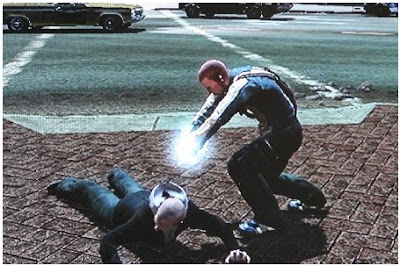 Good Cole healing a civilian in inFAMOUS
The most helpful stat is for the Karma Powers upgrades. There are 15 good or evil missions that must be completed to fully upgrade a power on either side; this is an exclusive arrangement - it's not possible to fully upgrade one particular "good" power if any opposing karma mission has been completed and vice-vera. 20% of players fully upgraded their Good powers, with only 8% of the players fully upgrading their evil powers.
So, less than a third of players who chose a full single path through the game chose to play as the bad guy. I'd like to believe that in real life, most people strive to do what they think is the right thing. People make mistakes, sure or are selfish or have misguided aims which cause what it right in one person's eyes to be wrong to others; but few people specifically aim to do the villainous thing. So, given the choice within a non-threatening environment like a game, why do so few gamers choose to explore boundaries by playing a proper anti-hero?
In "Why Dark Games are Good", Andy Robertson talks about "safe spaces for dark stories" in which he addresses the issue that there is nothing wrong with exploring darkness in an environment where it has no real impact. My own experience of playing as a villain in inFamous allowed me to explore some curiosity in my mind and feel liberated from game- and role-playing habits - but, more importantly I learned that ultimately the effect of seeking to improve, rather than destroy was far more rewarding. Playing violent or dark videogames doesn't turn you to violence - but it does and should provide a environment without real consequences to explore violence and bad choices and the impact that they have.
Perhaps it would do players some good to spend a little less time trying to be the hero and take the chance to learn why they don't want to be a villain.
1. Trophies and achievements, but I'm going to stick to the one term for this (back)
2. Based on users of playfire only - therefore probably tipped toward the more "hardcore" gamer (back)
One interesting aspect of inFamous is the once-ubiquitous moral choice system; which, in this case, translates into whether you play as a Hero, healing the sick and restraining criminals to face justice or a Villain, destroying baddies and citizen alike, destroying at will and sucking fallen victims' life forces to fuel your abilities. The only way to achieve the Platinum trophy in this game requires two play throughs. Once as a hero and once as a villain.
The first time I played this I made a choice: I really wanted to be the anti-hero. I'm a Live Role-Player and the idea of playing a character totally different to myself is always highly appealing. It occurs to me that in most games, even ones like GTA where you fill the shoes of a sort of anti-hero, you still end up taking mostly moral actions. I decided that, in playing inFamous, I wanted to be a proper villain. None of this "basically good at heart but makes wrong choices nonsense" - I decided that in my mind my character had been hurt, felt used and considered himself a victim and therefore lashes out at the world around him in order to inspire fear, if he can't win respect.
 Evil Cole from inFAMOUS
I bore no conscience about civilians caught in the crossfire. If I ran low on energy I would grab a passer-by to drain them of their vital energy. If there was the chance to rob somebody for rewards, rather than help them and hope for reward, I'd do it. Outside of the game's own mechanic was space for some personal expression through role-playing: fallen enemies (particiularly if they'd put up a tough fight and annoyed me) would be drained of their energy regardless of whether I needed it - it became an expression of vengeance. Being the villain was empowering, but ultimately lonely; People throw stones at you in the street, forcing you to have to live your life on the rooftops of the city, and your loved ones turn further away from you. But, as a game-play experience it was genuinely liberating and different to how most games feel.
Playing as a Hero totally changed the experience of the game. I had to modify my battle technique to avoid hurting civilians. More than that, there were similar role-playing experiences to what I had enjoyed as a villain. If I saw a sick pedestrian in the street I simply couldn't pass them by, even if I was in the middle of a chase. If I saw an injured criminals, my instinct was to use Arc Restraint (kinda like handcuffs) to hold them down to prevent them hurting anyone else. The civilians of the city rallied to my cause and even joined in the fight, assisting me by hurling rocks at the enemy, rather than me.
All in all it gives a compelling insight into the psychology of a driven humanitarian/broken vigilante or, as we more commonly name them: superhero.
What's interesting about Playfire stats, is that the majority of players choose to be a good guy. 26% of Playfire players have the platinum trophy and have therefore played both sides of the coin, so we'll discount them from our analysis. 35% of the remaining players finished the game as a Hero, while only 18% chose to finish the journey as a Villain.
 Good Cole healing a civilian in inFAMOUS
The most helpful stat is for the Karma Powers upgrades. There are 15 good or evil missions that must be completed to fully upgrade a power on either side; this is an exclusive arrangement - it's not possible to fully upgrade one particular "good" power if any opposing karma mission has been completed and vice-vera. 20% of players fully upgraded their Good powers, with only 8% of the players fully upgrading their evil powers.
So, less than a third of players who chose a full single path through the game chose to play as the bad guy. I'd like to believe that in real life, most people strive to do what they think is the right thing. People make mistakes, sure or are selfish or have misguided aims which cause what it right in one person's eyes to be wrong to others; but few people specifically aim to do the villainous thing. So, given the choice within a non-threatening environment like a game, why do so few gamers choose to explore boundaries by playing a proper anti-hero?
In "Why Dark Games are Good", Andy Robertson talks about "safe spaces for dark stories" in which he addresses the issue that there is nothing wrong with exploring darkness in an environment where it has no real impact. My own experience of playing as a villain in inFamous allowed me to explore some curiosity in my mind and feel liberated from game- and role-playing habits - but, more importantly I learned that ultimately the effect of seeking to improve, rather than destroy was far more rewarding. Playing violent or dark videogames doesn't turn you to violence - but it does and should provide a environment without real consequences to explore violence and bad choices and the impact that they have.
Perhaps it would do players some good to spend a little less time trying to be the hero and take the chance to learn why they don't want to be a villain.
1. Trophies and achievements, but I'm going to stick to the one term for this (back)
2. Based on users of playfire only - therefore probably tipped toward the more "hardcore" gamer (back)
Tuesday, 22 March 2011
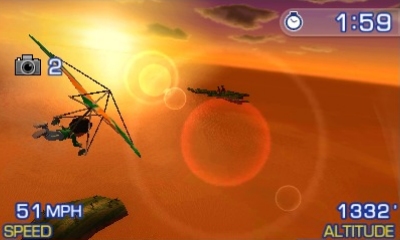
Novel Gamer Episode Eight - Pilotwings Resort, or "Learning to fly"
This is the eighth episode of the popular online alternative review column "Novel Gamer", part of Game People, which specialises in real world, alternative and artistic reviews. Don't forget that a podcast is also available from the source of this article, here.
This week, awoken by a mysterious message on his computer screen, an invitation leads Geo to a waterside warehouse where he must ask himself: does the Matrix have him? Or is the truth about the other side of the screen far more incredible?
This weeks' Novel Gamer review is based on reactions to a pre-release launch experience of PilotWings and is a preview, than a review based on a full assessment of the game.
This week, awoken by a mysterious message on his computer screen, an invitation leads Geo to a waterside warehouse where he must ask himself: does the Matrix have him? Or is the truth about the other side of the screen far more incredible?
This weeks' Novel Gamer review is based on reactions to a pre-release launch experience of PilotWings and is a preview, than a review based on a full assessment of the game.
...Wake up Geo
That was what the monitor screen said. It's appearance, unbidden, on my display had woken me from my light slumber as I lay on my couch with my DS on my chest. The battery had obviously died some time before. I was so tired when I had been playing I actually had no idea what I had been doing or what progress I may have lost.
At least I thought the text on the screen had appeared. I could picture it, but now the screen was blank. I half remembered that actually that was the beginning of a movie, so maybe it hadn't happened at all?
I stumbled into the kitchen, drew a glass of water, tipped some cereal into a bowl and sat down. The milk looked okay and I'd only bought it a couple of days before, but I still unscrewed the cap and gave the contents a sniff, automatically. Some habits you just get used to.
That day -- more than any other day -- I was strangely aware of my senses. The floor, between the kitchen table and the fridge had a slightly tacky patch. Not actually sticky, but maybe a place where a spill had once happened and been cleaned up, leaving only the faintest of adhesive traces. One end of the room seemed slightly darker, as though perhaps the bulb on that side of the fitting was on its way out. Condensation had formed on the tap spout where the cold water had escaped its confines for the alternative comforts of my glass.
There could be any number of reasons for my heightened feelings on that day. But, the reason I prefer to cling to is because that was the day I was about to have my eyes opened to a new world.
I've always been a gamer. From my earliest memories I recall slipping into an alternative world of adventure and intrigue on the other side of the screen. For me games have always enabled me to lose myself in an alternative reality. Much more than film with its fixed view on the action and its set narrative. The only other route I have ever found as effective for escaping from this world is books. It's not for everyone, but for the confident reader the barrier of the ink on the page melts away and the words and ideas are transported directly into the brain; to fire the imagination and to create a witness eye view on events that are unique to the reader.
The problem with games has been the thing it shares with film: the screen. In spite of its ability to display incredible vistas, gravity-defying moves, heart-breaking empathy and deep intrigue, it is the screen that reminds us we are trapped. Trapped in a world of mundanity, tethered to practicality and shackled to domestic limitation.
The screen gives us window into a world that is more alive and that accepts fewer excuses for what "cannot be done" within the bounds of physical reality.
That day was the day a man came who took the barrier away and enabled me to soar in the skies, as I used to in my childhood dreams.
If I could not be sure that I had seen the cryptic movie pastiche on my monitor I was in little doubt as to the reality of the card that had been pushed through my door.
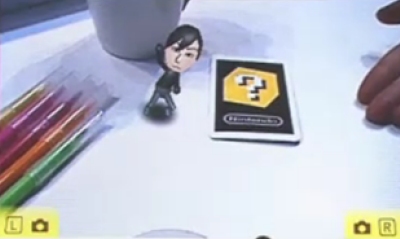
It was clearly meant to serve as a business- or calling-card; however, it's dimensions were more reminiscent of a playing card. That certainly grabbed my attention. It featured a simple "?" mark.
I turned the card over, half anticipating something from the world of literary cliché: the ace of spades maybe, or the Tarot figure of Death grinning up at me. Instead, the reverse of the card featured a simple typed message: a local address and a time.
Looking at my watch I saw that I had just enough time to get ready and get to this meeting. There could be no question of my not following this invitation. Not only was the "?" mark on the card reminiscent of the prize boxes in Super Mario, but I couldn't help but think that if I had slept any longer I would not have been able to make this appointment; I thought back to those ghostly words on my screen.
I walked down to the docks. The address I had been given was for a waterfront warehouse, next to a small cafe. I decided I had no time for a tea break and headed inside. I was too excited about the wonder of this invitation to delay.
In the centre of the room stood a tall, imposing man in a long, black, leather coat. Beside him on a table was what appeared to be a Nintendo DS.
"Welcome, Geo" the man intoned. "I am glad to meet you. I believe that you are a man with a problem. A problem I hope to solve."
I nodded my head, "you're talking about the games."
"I'm talking about the reality you create for yourself, Geo. You who have always loved the excitement of exploring other worlds and doing things that no person could hope to experience in reality but who always feels like you are kept on the outside. Are you ready to go deeper into the game?"
I frowned, trying to understand. "You're talking about increased immersion?"
He replied, quickly, "I'm talking about reality, Geo. What is real? If real is what you can feel, smell, taste and see, then 'real' is simply electrical signals interpreted by your brain. If you can convince your brain that an image you are seeing is in three dimensions -- 'appears' solid -- then who is to say it is not real?"
He held up his hand dramatically and I could see that he was holding a pair of old-style 3D glasses, with coloured lenses. "You have a choice," he announced, "look through the blue lens and you will see the world as it has always been, flat and dull ... ummm..." he faltered, "and looking a bit blue..."
I raised my eyes to the ceiling. The dramatic mood had been broken.
He continued unabated, "look through the red lens and you'll see, well, exactly the same thing." I think he sensed he was losing me, as he went on, hurriedly, "but if you look through both -- here's the thing -- it also changes nothing! What I am about to show you doesn't require glasses." He threw them over his shoulder and they landed in a puddle of water leaked from somewhere high in the ceiling.
He opened up the machine on the table. "This," he declared, "is the Nintendo 3DS and it will show you a world of which you have only dreamed." He stuck out a hand towards me, palm up, "the card, please."
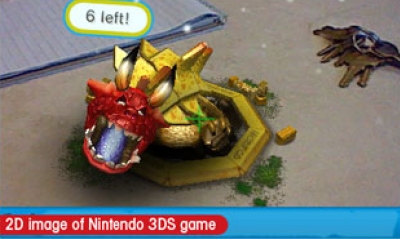
I reached into my pocket and recovered the calling-card that had been pushed through my door. As I placed the card down on the table, "?" mark facing up, he handed me the 3DS and I focused on the image of the card on the screen. It wasn't like looking through a camera lens. It was like seeing the table in front of me with fresh eyes. A 3D viewport onto the world as it is. Then the 3DS showed me the world as it could be: the card unfurled, revealing a deep recess in the table. A dragon head on a long neck extended out and toward me.
I was reeling, "but this is incredible!" I called out.
"Patience, Geo," he said, raising a hand "I agree this is impressive, but the dragon is only to demonstrate that the world is not necessarily as you see it. Let me show you what you are really here to see; what you really came to do..."
*****
I felt myself soaring high above the ground, floating over the sea and onward, ever toward my target. The clouds parted and I saw the world laid out before me. It was like the world, only at the same time not like it. It wasn't drab, grey and mundane -- this was a world inhabited by living colour as though the sea was trying to be as blue as it could be and the grass exerting itself to be the greenest grass the world had ever seen.
The world was so ... if I had to settle for a word, I'd have to go with 'real'. Not the kind of real I expected. It was not our world reproduced on the screen. If anything it was the reverse. It was as though the world of the games had been made solid and brought into our reality. Before, these places had always seemed like colourful sketches in some framed picture I could never enter. Now they lived and breathed in three dimensions and it was like seeing a cartoon hero come to life.
The flying itself was breathtaking. The ease with which I could soar through floating rings seemed to come naturally to my fingers and I glided over the beautiful island paradise and landed the aircraft gently on the waves exactly as I had been taught.
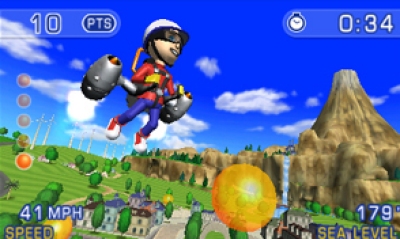
The dream changed and I found myself hanging in the sky, held aloft by a jetpack. It was a fun variation on the controls required by the plane and I propelled myself forward, through balloons onward towards the goal.
The dream changed once more -- now I was whooshing over the mountaintop, suspended from a hang-glider. The world was so deep and so intense and I wanted to explore every part of it, but I felt myself being pulled away.
I blinked and found myself back in the room with the stranger.
"How was it?" he asked me.
"I feel," I struggled to find the words, "I feel like I've held a world in my hands, a world that I can enter whenever I choose and fly over, under, through and across. I want to explore every inch of that world from my vantage point in the sky. It felt real. It was almost too deep. Sometimes I felt like the gulf of depth was too massive and I wanted it to feel a bit flatter... incredible."
I rubbed at my eyelids, "why do my eyes hurt?"
The figure looked at me poignantly, "because you've never used them before."
I made to pick up the Nintendo 3DS again. I desperately wanted to fly some more.
He stopped me. "That is all you can see for now. It is time for you to return home."
I was incredulous, "but I've just seen the most incredible things! I've seen the world of games as it could be and I'm not sure if I can return to the other side of the screen! I want to spend more time here and see more and fly more..."
He nodded, kindly, "the world you seek is coming soon, Geo. It is only a few short weeks away and you will be able to return to the real side of the screen again. For now, you must spread the word that others may be enlightened."
*****
My alarm clock beeped loudly and I awoke. I could hear the rain lashing against the glass.
I rubbed the sleep from my eyes and, in doing so, I remembered the adventure with the Nintendo 3DS. I remembered getting my pilot wings and soaring high above the ground.
I looked out of the window and could see blue sky breaking between the grey clouds. I had had the most incredible adventure, journeyed to a colourful world and flown... and then had it taken away before I was ready; before I had had a chance to see it all.
The memory felt like the aftertaste of a sweet dessert in my mouth. In my heart I knew I was desperate to fly again. It had all felt so real to me.
It couldn't have been a dream, could it?
Thursday, 17 March 2011
Novel Gamer Episode Seven - Starship Patrol, or "Commander on Trial"
This is the seventh episode of the popular online alternative review column "Novel Gamer", part of Game People, which specialises in real world, alternative and artistic reviews. Don't forget that a podcast is also available from the source of this article, here.
This week, a space fleet commander - on trial for competency - must justify his actions and approach to a controversial fleet battle, amid tales of weapons shortages and very basic video displays.
This week, a space fleet commander - on trial for competency - must justify his actions and approach to a controversial fleet battle, amid tales of weapons shortages and very basic video displays.
Across the stars, nestled between floating chunks of space rock and debris, the Space Station Zenobia drifted along in its quiet orbit between the planetary mass hundreds of miles below and the nearby moon.
Commander Jayston stood up from his seat in the congregational chamber and placed his hands on the wooden bar of the dock. He faced the panel of senior officers before him and awaited their instruction.
Admiral Langford eyed him impatiently, as if unaware that the assembled court was waiting upon his word to commence. His head was slightly bowed and he frowned as he stared at Jayston through thick white eyebrows. He opened wide a thin pair of cracked, wrinkled lips to reveal a small row of yellowed, gravestone teeth and barked commands.
"Well, man? The oath! Get on with it."
Commander Jayston raised his hand in the air. "I swear that my testimony shall be the truth, the whole truth and nothing but the truth."
The Admiral clicked his tongue in acknowledgement and straightened up, eyeing the assembled crowd. "In that case," he declaimed, "I declare this initial meeting of the military competency hearing panel open."
He locked eyes with Commander Jayston once more, "you understand that the purpose of this hearing is to hear a full account of your version of the events that took place on the outer rim during your campaign?"
Jayston replied, "yes, sir."
The old man continued, almost without waiting for the response "and you understand that this hearing is not questioning the outcome of that campaign - generally considered to be quite satisfactory - but rather to establish the efficacy of your conduct and approach in its execution? There are a number of areas in which your performance has been called into question, on the basis of the official logs, recordings and witness testimony."
"Yes, sir."
Another officer to the Admiral's right, whose name plaque declared him to be Admiral Bryant, spoke up. "Perhaps, Commander, you could begin by telling us how the conflict started?"
"We set out to perform a routine survey of an alien system, but were set upon at every turn. Nevertheless our orders were to proceed with the mission." Jayston replied.
Admiral Langford curled his lip. "I see," he growled, menacingly, "and that brings us to the first of your engagements with the enemy. Can you explain to us, Commander, exactly why you went into your first battle with the enemy entirely un-armed?"
"Well, sir," Jayston stammered, "The ships had been built with a number of standard mounting-ports to which weaponry could be assembled at short notice -- however due to the available resources we did not have any standing defences."
The panel murmured and shared glances between themselves. "So what did you do when the first enemy craft began attacking?"
"We generally have enough resource budget for two slow-repeating lasers or one missile silo depending on circumstance. Owing to our tactical systems we were able to predict the flight path of each enemy wave. We placed the weapons such as we had in what I felt to be the optimum position to handle each encounter. As the enemy fell, we recovered what resources we could from these craft and converted them into additional weapons as the exchange continued."
"And this is standard practice, is it?" Admiral Langford enquired.
Commander Jayston nodded, curtly, "in these kinds of engagements, I believe it to be a common type of defensive strategy."
"So," Admiral Langford cut in, "you faced the enemy with your fleet, based upon a hand-to-mouth strategy whereby the resources generated by one defeated wave would feed into your defences for further attacks?"
The defendant nodded once more, trying to anticipate the Admiral's next barbed comment as accurately as his ship was able to determine an enemy's flight path.
The Admiral leant back languorously in his chair and cast a hand theatrically around the assembled room. "Am I the only person present who feels it would be a more appropriate strategy to meet the enemy with a properly prepared and equipped defence grid? Rather than deploying weapons one at a time to meet specific engagements?" His voice rose dramatically in line with the hyperbole.
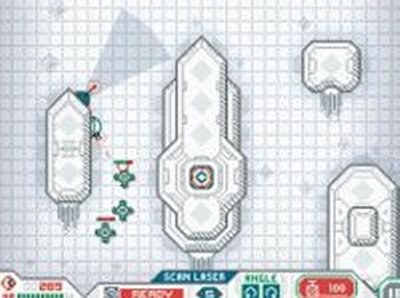
"But, Admiral," Commander Jayston protested, "we really only had enough budget to deploy two weapons!..."Exhibit A: The tactical display of the battle
There was a general murmuring in the court which had to be quietened by the officer on the other end of the panel, another Admiral by the name of Bellingham.
Admiral Langford himself leaned toward Jayston and smiled sweetly. It reminded Jayston of the way a crocodile looks as it glides effortlessly through the water. He gulped, involuntarily.
"That budgetary issue being the case, Commander," the Admiral said, at last, breaking the tension, "with what defences did you begin the second engagement?"
Jayston chewed on his lip, "ummm, none, sir."
Langford put on a faux expression of confusion, "but by the end of the first battle you must have amassed quite a sizeable arsenal?" Why was this not re-deployed when the enemy attacked a second time?"
Silence fell heavily upon the room, awaiting Jayston's answer. He finally said, simply, "I don't know, sir."
The Admiral pursued him, "I cannot think of a good reason why the resources available to your fleet should not be made available in subsequent battles. Can you?"
Commander Jayston simply shook his head.
The three admirals behind the long counter exchanged glances with one another and then bowed their heads to make notes, almost in unison.
Admiral Bellingham spoke next, "Commander, perhaps we could move on to the issue of your performance in the individual skirmishes. This appears to be a very mixed area. In some battles you display an exemplary performance -- occasionally leaving the enemy without a single remaining unit -- while in other battles you barely escape with your fleet intact. Do you have an explanation for this fluctuation in your abilities?"
"Yes, sir, I do," Commander Jayston replied hopefully, "I believe that the primary responsibility for our variable success with the enemy must lie solely at the feet of our Research and Development department."
This prompted an explosion of coughing and outraged bluster from Admiral Langford. "What?" he demanded, "you blame the weapons development team for this? Explain yourself!"
"Certainly, sir," Jayston replied, "throughout the campaign, R&D occasionally provided new weapons based on their work and the alien encounters. However, the enemy demonstrated time and time again that they were capable of deploying cloaked ships which were impervious to all but a minority of our weapons. In spite of the effectiveness of these enemy units and the problems which they caused us in our defence, R&D failed to provide any weaponry which was effective against these craft. In desperation I had to form my own approach -- while the mine layers are generally ineffective they do cause the enemy ships to de-cloak at which point better weapons could be brought to bear. However the effectiveness of mines is unpredictable and results are largely random. Sir."
Admiral Langford had an expression on his face which looked as though he were trying to remove stuck gum from the roof of his mouth. "I see," he eventually replied.
Bellingham chipped in, "but it's not all down to the weapons, is it? Some of the targeting is off! Why we have pictures here which show your most effective weapons firing upon lone, weak targets while elsewhere three heavily armed fighters attack your ship!"
Commander Jayston retorted, quickly, "I have very little control over the targeting, sir. All I can specify is an area in which the guns will fire. They choose their own targets -- very poorly if I may say so, sir."
"And to what," Langford said, slowly, "do you attribute this failure?"
Jayston thought for a moment, carefully -- he didn't want to dig himself further into a hole but he didn't feel he could go any longer without raising this particular issue. "I think the fault is the graphics display, sir."
The admirals raised a line of eyebrows, almost as if choreographed.
"The tactical display looks like.. like.." he struggled for the right words, "well sir it looks like it's been hand drawn on lined paper! It's hardly representative of a real battle, is it? Umm, Sir."
Admiral Bryant asked him, "what would you prefer?"
The young Commander was a little taken aback by this question, "well Sir... I ... ummm... think it would be more effective, given the setting, to be presented with a realistic camera display of the ships involved in battle."
Langford picked up his colleagues line of questioning. "Commander, what colour is space?"
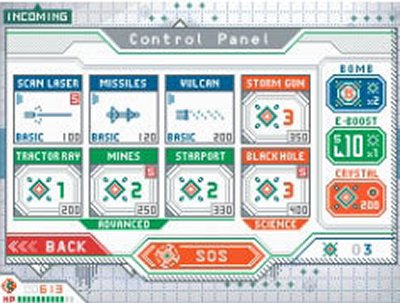
"Black, sir."Exhibit B: Weapons often available by the end stages of a battle
"And are most of the enemy ships a brilliant white, or a different colour?"
"Umm mostly darker colours than white, sir."
"And the projectiles and resources involved -- are they dark or light colours, in reality?"
Jayston's heart felt like it was plummeting through depths to rest at the bottom of a deep lake. "They are dark colours, sir."
Admiral Bellingham said, "whereas the graphical display for your fleet's command console displays the enemy on white screens with clear black outlines and makes all resources and projectiles very clear."
The Commander chose to not respond to this statement.
"Do you still feel that the display style is at fault, Commander?" Langford asked him, bluntly.
"No sir." Jayston replied. What else could he say? He watched dust particles dance in the rays of light coming through the viewports behind the panel. Was this to be the end of his career?
The three admirals adjourned to a private room to discuss the facts. It seemed to Jayston as though there was no hope.
The waiting seemed eternal, although in actuality less than five minutes had passed. The ante-room door opened and the three stooped, elderly soldiers filed back into the room.
Admiral Langford looked intently into Jayston eyes. "Having looked at the records of your performance and the overall outcome of the campaign -- as well as other mitigating factors -- we find no grounds on which to bring charges of misconduct or competency. You are free to leave."
Jayston was stunned; but at the same time he was suddenly curious. "If I may ask, sir... what other mitigating factors?"
The panel simply stared at him and offered no response.
Moments earlier, the panel of three judges had congregated in the ante-room behind the congregational chamber. They exchanged glances.
"Well," Bryant was the first to speak, "what do you think of it all?"
Langford growled, "I don't like him. Starting a battle with no defences, refusing to redeploy weapons once they are positioned...."
Bryant cut in, "his records indicate that he found the budgetary cost of removing a weapon once it was installed was prohibitive to making any changes. His complaint about this is noted in his report."
There was a moment where nobody spoke -- just thought about how to pass judgement on this episode.
Admiral Bellingham cleared his throat, softly and with a conspiratorial tone, suggested "we could of course look at this from a sideways perspective. Due to the way in which Jayston's fleet is housed he can be called upon at a moment's notice -- rather than some other war games which require us to find the appropriate records and install them. Also, this whole incident hasn't cost very much."
"Cost?" Langford demanded, "what do you mean?"
"Well," Bellingham continued, "according to our records this whole affair has only cost our department 500 DS Points."
Langford and Bryant looked at each other and raised an eyebrow. "We should probably overlook a few indiscretions, then?" Bryant offered.
Admiral Langford nodded gravely, "I think," he announced with an air of pontification, "that that is exactly what we should do."
Subscribe to:
Posts (Atom)